
Does an average size fully describe ingredient quality?
Not necessarily. Relevant coarse or fine fractions can be hidden by one summary value. Report the distribution information required by the quality decision.
product has always been of great significance in food production. Taste, color, solubility or extraction behavior are only a few examples of product properties which are directly influenced by particle size. Traditionally, analytical test sieving provides a quick and simple possibility to characterize the particle size of bulk goods.
In a running production process, the results of a quality check must be available quickly to allow for immediate adjustment of the production parameters. Depending on the expected particle size and sample volume, different sieving methods and sieving machines are suitable for analysis.
The method used for particle size analysis is primarily determined by the fineness of the material to be sieved. The classic methods of sieving bulk goods with vibratory, horizontal or tap sieve shakers are limited to sizes above 40 microns. When using vibratory sieve shakers for wet sieving, it is possible to push the limit to 20 microns. However, this method involves dispersion of the sample in liquid, filtration after sieving, drying and finally weighing the obtained fractions. For dry sieving of samples with particle sizes below 40 microns, air jet sieving is the method of choice. It can also be a faster alternative to vibratory sieving for particle sizes up to 200 microns. All methods mentioned here are suitable for determining the the undersize and oversize (so-called sieve cut) as well as the particle size distribution of a sample.
Tap Sieve Shaker AS 200 tap
Vibratory Sieve Shakers AS 200/AS 300/AS 400/AS 450
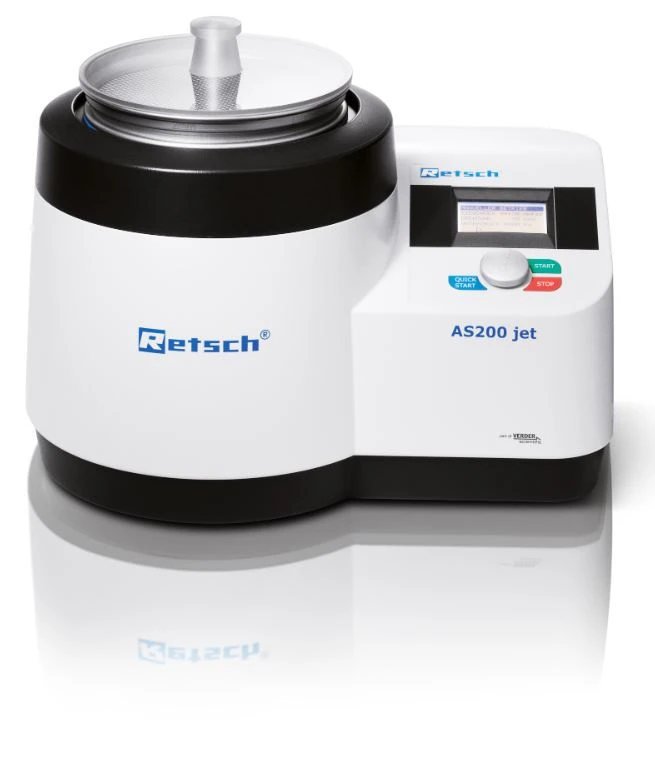
Air Jet Sieving Machine AS 200 jet
“We were advised by our colleagues from Chicago to use the RETSCH air jet sieve and they were right.” Evgenia Slavina, Wm. Wrigley Jr.
PERFORMANCE DATA
separation, fractioning, particle size determination
Feed material:
powders
Measuring range*: 10 µm - ~ 4 mm Max. batch:
0.3 - 100 g
Max. Number of fractions: 1 (by using
a cyclone: 2)
VIBRATORY SIEVE SHAKER AS 200 CONTROL Applications:
separation, fractioning, particle size determination
Feed material:
powders, bulk materials, suspensions
Measuring range*: 20 µm - 25 mm Max. batch:
3 kg
Max. number of fractions: 9 / 17
Test sieving of talc powder for chewing gum production
In the testing laboratory of the St. Petersburg branch of LLC Wrigley RETSCH sieve shakers AS 200 jet and AS 200 control are utilized for particle size analysis of fine powders which are used for chewing gum production.
Wm. Wrigley Jr.
“Regular sieving machines cannot separate fine powders such as talc”, explains Evgenia Slavina, a Quality Assurance Specialist in the testing laboratory. “Talc is used in chewing gum production to prevent adhesion of plates in the package (a so-called “rolling compound”). The fineness of the powder should not exceed 40 microns. The air jet sieving machine AS 200 jet helps us to control this parameter here in our laboratory. We were advised by our colleagues from Chicago to use the RETSCH air jet sieve and they were right. We use it with the powerful industrial vacuum cleaner GM80 which provides sufficient airflow to break the agglomerates. Thanks to adjustable nozzle speed and open mesh function the AS 200 jet is very flexible and makes the sieving process easy and totally reproducible.”
In confections manufacture the fineness of acids also plays an important role. It should not exceed 150 microns to provide the desired solubility of the product. Sieving of such powders in an air jet sieving machine is a faster and more reliable alternative to vibratory sieving.
RETSCH’s vibratory sieve shaker AS 200 control is also used in the laboratory for fractional analysis of sugar and different sweeteners. The reproducibility of the sieving process due to digital control of all parameters, as well as a wide range of high quality test sieves make handling of this instrument reliable and easy.
The Wm. Wrigley Jr. Company is a recognized leader in confections with a wide range of product offerings including gum, mints, hard and chewy candies, lollipops, and chocolate. The company has operations in more than 40 countries and distributes its brands in more than 180 countries. Wrigley is headquartered in Chicago, USA, and operates as a subsidiary of Mars, Incorporated, a private, family-owned company founded in 1911. Since 1992 the company operates in the Russian market. It owns a factory in Saint Petersburg which was built in 1998.
Plan the configuration for your material.
Choose a separation procedure that reflects the ingredient's behavior and the quality question. A coarse retained fraction and a fine-particle tail can carry different meanings. Keep the sampling, sieving conditions and reporting basis consistent before comparing suppliers or batches.
| Consideration | Information to provide |
|---|---|
| Ingredient | Physical state and composition |
| Quality question | Fraction linked to the process |
| Comparison basis | Same preparation and sieving method |
How should the application examples be used?
The results describe the materials and configurations discussed here. Confirm equipment options, contact materials and operating conditions for your own sample before adopting a method. A demonstrated endpoint does not guarantee the same outcome for a different material.
Discuss material testing with Glen Mills or request further information or a quote.
Explore the equipment discussed
- RETSCH AS 200 jet Air Jet Sieving Machine
- RETSCH AS 200 Control Sieve Shaker
- RETSCH AS 200 Tap Sieve Shaker