
Can increasing shaker intensity improve every cereal-flake test?
No. Excessive motion may damage the sample or hinder separation. Evaluate the method against the material's behavior and the required measurement.
Graduate student Jennifer Franz has developed a new inspection procedure during her work at the German food producer Lebensgarten GmbH. With the help of sieve analysis the company can now reliably ascertain the fines and dust fractions of incoming cereal flakes; these have a negative influence on the mixing and packaging process of muesli.
The dust fraction consists of particles <500 microns and prevents tight sealing of the packaging by sticking to the welding seam. Another negative effect occurs during the production of so-called ‘crunchy’ products. Crunchies are crisply baked cereal flake products; by adding honey, for example, the ingredients are formed into a compact mass and are then baked. The higher the dust fraction, the more crumbly and fine-
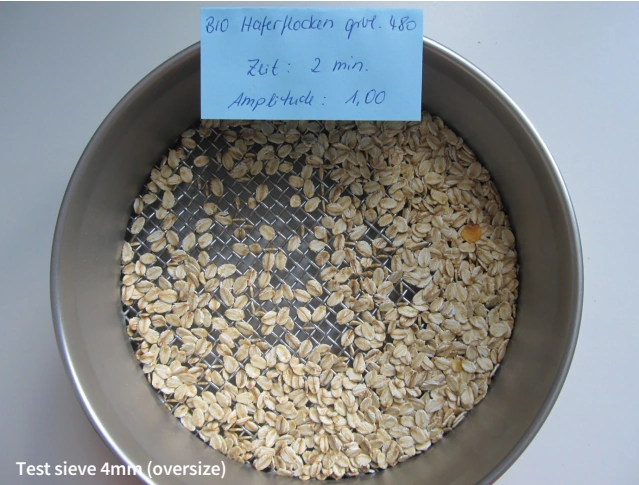
Test sieve 4mm (oversize)
Test sieve 2mm (broken flakes)
pored the consistency of the crunchies becomes. Separating the flakes into individual fractions by sieve analysis reduces these negative effects on the product quality by allowing reliable quality evaluation.
New inspection procedure
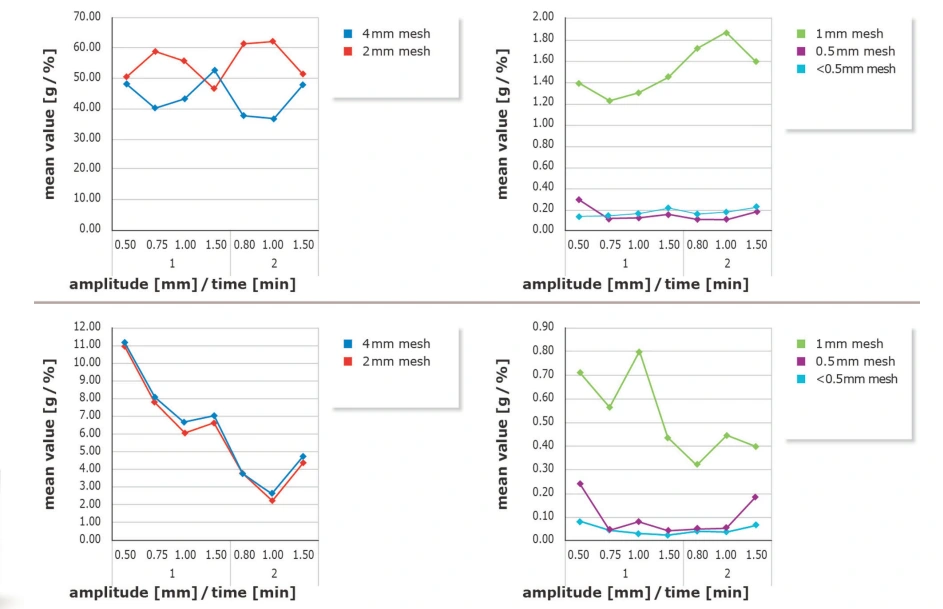
The mixture of cereal flakes can be divided into different particle size fractions which are roughly whole flakes, half flakes, broken flakes and fines. The aperture sizes of the sieves used are 4mm, 2mm, 1mm, 0.5mm and <500µm (sieve pan). This last fraction is considered as the dust fraction which has a particularly negative influence on the packaging and production process. Before selecting the time intervals for sieve analysis, the structural composition of the flakes was evaluated. Based on the fact that cereal flakes are categorised as a fragile raw material which breaks easily and is subjected to natural deviations, a time interval of two minutes was defined. To ascertain a suitable amplitude for each flake type, care was taken that the flakes were not thrown with too high or too low intensity. If the throwing intensity is too low, the flakes are not properly dispersed resulting in low separation efficiency. If the amplitude is set too high the low-density particles are held in suspension and a comparison of individual flakes with the sieve apertures is not possible. For flakes of oat, wheat, rye, spelt or barley amplitudes of 0.9 or 1.00mm
Test sieve 1mm (fines, coarse)
(instable flakes) and 1.5mm (stable flakes) were chosen according to the stability of the flakes. Four different sieving protocols were defined for the cereal flakes by experimental sieve analysis. This test series shows that sieve analysis is a highly suitable method to control the quality of the raw materials by separating the fines and dust fractions.
Vibratory Sieve Shaker AS 200 control
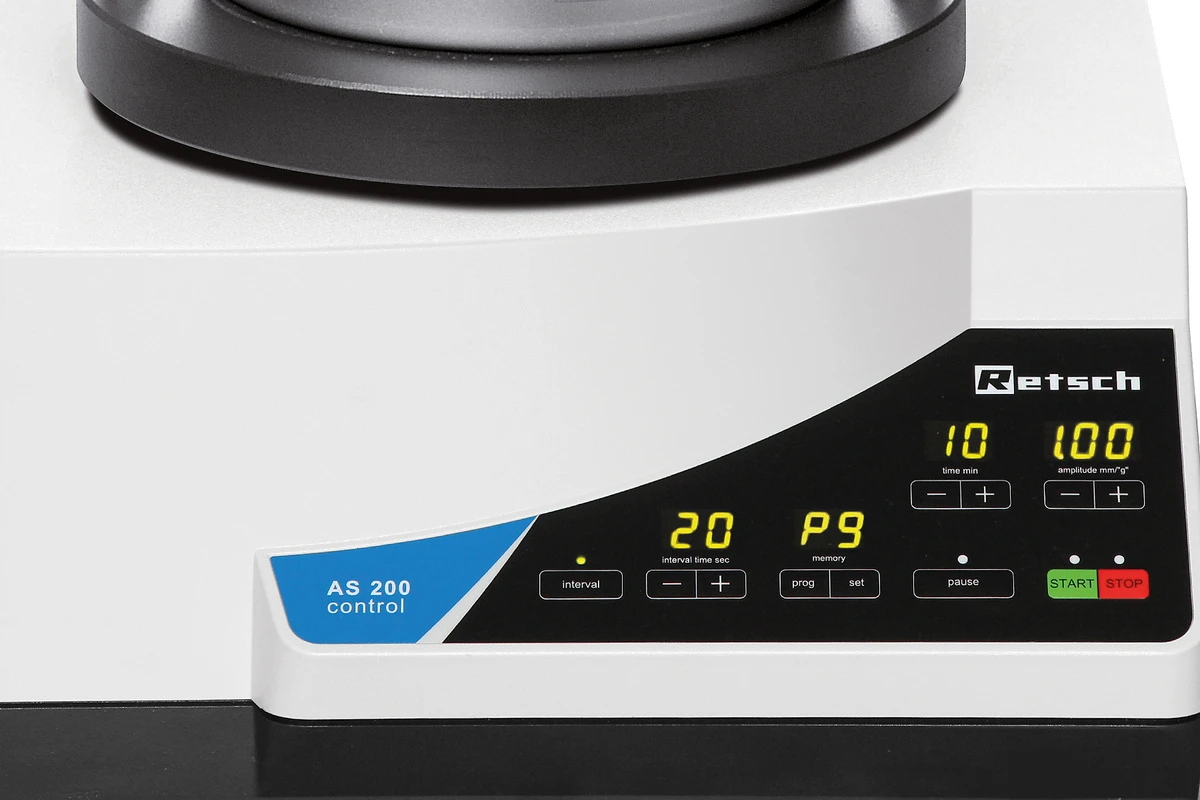
Jennifer Franz carried out the test series with a RETSCH sieve shaker AS 200 control. The patented controllable electromagnetic drive of
Definition of flake fractions
Test sieves (sieve apertures in mm)
Definition of the flake fractions oversize broken flakes fines (coarse) dust (coarse) dust (fine)
Test sieve 0.5mm (dust, coarse)
RETSCH’s vibratory sieve shakers allows for optimum adaptation to the material to be sieved. The drive produces a 3D throwing motion that moves the sample equally over the whole sieve surface and effectively separates particles in a size range from 20µm to 125mm. The sieve shakers accept a variety of sieve diameters from 100mm to 450mm. Sieve stacks with a maximum height of 450mm allow for separation of up to 17 fractions in one analysis. The ‘control’ series features digital setting and control of amplitude, time, sieve acceleration and interval. Up to nine parameter combinations can be stored to conveniently repeat routine analyses.
SIEVE SHAKER AS 200 control n 3-D throwing motion, powerful electromagnetic drive n Excellent separation efficiency even with short sieving times n Setting of sieve acceleration ‘g’ for comparable and reproducible sieving results worldwide n Free digital adjustment of all process parameters
Sieve pan <0.5mm (dust, fine)
Plan the configuration for your material.
Fragile flakes may change during the test if the motion is too aggressive. Establish conditions that separate the material without turning the measurement into an unintended breakage process. Document the incoming sample, sieve fractions and mass balance so that supplier or batch comparisons refer to the same procedure.
| Consideration | Information to provide |
|---|---|
| Flake condition | Fragility and starting mixture |
| Sieving motion | Separation without unwanted breakage |
| Results | Fines fraction and recovered mass |
How should the application examples be used?
The results describe the materials and configurations discussed here. Confirm equipment options, contact materials and operating conditions for your own sample before adopting a method. A demonstrated endpoint does not guarantee the same outcome for a different material.
Discuss material testing with Glen Mills or request further information or a quote.