
Does observing a temperature value establish temperature control?
No. A measurement describes a location in the process. Control and the sample's actual thermal history need to be evaluated for the complete arrangement.
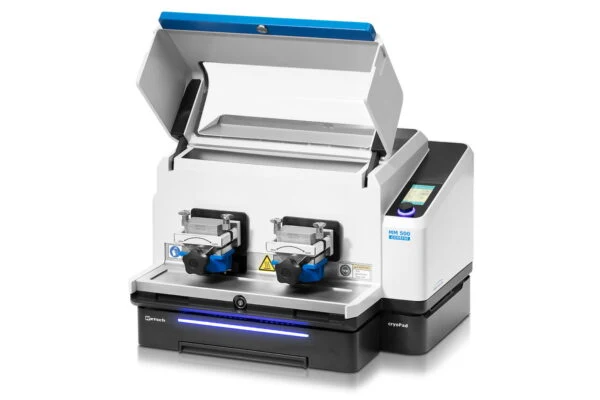
The first ball mill which is capable of tempering samples during a grinding or chemical process in the range from -100°C to +100°C.
There is a wide variety of solid samples that require homogenization for subsequent analysis. The temperature at which the grinding processes take place can play an important role for various reasons. Generally, heat is generated during the grinding of solids. This is problematic if highly volatile components or other ingredients of the sample are to be preserved for subsequent analyses. Moreover, not all materials can be successfully homogenized at room temperature due to their physical properties. In chemical syntheses and mechanochemistry, temperature also plays a decisive role in controlling the reaction.
For these applications RETSCH has developed the Mixer Mill MM 500 control, which can cool two grinding jar positions with grinding jars up to max. 125 ml simultaneously. The heart of the MM 500 control are the flexible tempering options. Where, for example, the RETSCH CryoMill exclusively uses LN2 as a cooling medium so that the samples always reach temperatures in the range down to -196°C, the MM 500 control offers various cooling and also heating options. By connecting to either a chiller, a cryostat or RETSCH's innovative cryoPad, which regulates the flow of LN2, temperatures in the range of -100°C to +100°C can be generated with various thermofluids. This opens up completely new possibilities especially in the field of research and development, in mechanosynthesis or also for applications with polymers or food.
MM 500 control with cryoPad
Innovative concept for temperature control of samples
During a grinding or mechanical synthesis process a certain sample temperature is established. This depends on the sample type, the grinding jar volume and material, the ball size and number as well as the frequency/speed and process time. Since often only the last two parameters can be freely selected, a temperature development above 100°C is not unusual, especially in the case of nanogrinding or, generally, in the case of longer grinding processes with larger balls. Without active cooling options, excessive temperatures can only be reduced by using cooling breaks.
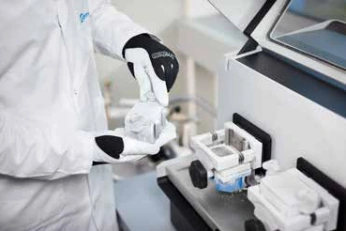
The innovative MM 500 control offers the possibility to be connected to a chiller, a cryostat or to the cryoPad, which allows active cooling or heating. By means of these temperature control units, cooling liquids such as water, water-glycol mixtures, ethanol or LN2 are pumped through thermal plates, thus covering a temperature range from -100°C to +100°C. The grinding jars are placed and fixed directly above the thermal plates. Flushing the thermal plates, for example with 4°C cold water, leads to active but indirect cooling of the grinding jar and thus also of the sample inside. This process causes a significant temperature reduction in the grinding process; depending on the configuration, even below room temperature. When employing cryostats and thermal oils, the thermal plates can also be used to heat the grinding jar and reach higher temperatures.
The novel cryoPad uses liquid nitrogen as a cooling medium and regulates its supply. The user selects a target temperature between -100°C and 0°C in steps of 10, and the cryoPad regulates the temperature of the thermal plates to this value. This makes the MM 500 control the only ball mill on the market that offers true temperature control. A special feature for the operation of the MM 500 control with cryoPad is the possibility to define a cooling time. This means that, after reaching the set temperature, the machine continues to cool for the defined period of time before the actual grinding begins, so that the sample and the balls inside the grinding jars can also adjust to the set temperature of the thermal plates. Furthermore, due to the different temperatures in the negative range, the MM 500 control is able to perform cryogenic grinding even at temperatures higher than -196°C. For many food samples, for example, these very low values are not required, freezing the sample at, e.g., -40°C is sufficient. In the field of mechanical synthesis reactions, for example, it is quite interesting to work with different temperatures and compare the results.
Grinding of temperature-sensitive samples while preserving all analytes
There are a variety of reasons why samples are temperature-sensitive. On the one hand, there may be ingredients that are to be analyzed after sample preparation but are altered by the actual process due to excessive heating. This may be a chemical change such as denaturation of proteins or amino acids in biological samples. It can also be a structural change of the analytes, for example, if the lattice structure of the analyte changes. On the other hand, many ingredients are highly volatile which means, their chemical structure remains intact, but at relatively low temperatures they become gaseous and evaporate from the sample to be analyzed.
Consequently, only partial amounts of the actual analyte are detected in the subsequent analysis, or the analyte has even evaporated completely. In the case of food samples, these are often aroma compounds such as vanillin, menthol or terpenes in essential oils. In roasted coffee, for example, one of the volatile aroma compounds is carbonyl. It is also possible that heating during a grinding process creates a certain ingredient, such as polycyclic aromatic hydrocarbons (PAHs) or acrylamides in foods. If the laboratory sample was free of these components and only the sample preparation introduced them, the contaminant analysis would be strongly falsified. In green coffee, heating could possibly contribute to the formation of certain aroma substances and likewise impair the analysis.
In all these cases, it is therefore imperative that sample preparation is carried out as gently as possible with regard to possible heating. The MM 500 control is ideally suited for this purpose thanks to its various cooling options.
Deeply frozen grinding jars after cryogenic grinding with the MM 500 control
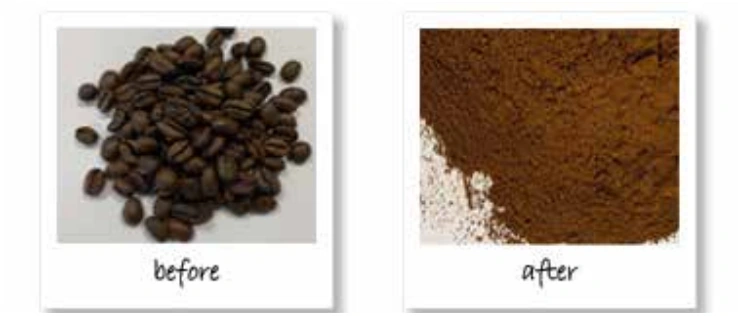
Left: Roasted coffee before and after grinding in the MM 500 control (per 125 ml stainless steel grinding jar: 5.4 g coffee, 8x20 mm stainless steel grinding balls), set temperature -100°C, 25 min precooling time, grinding in 10 cycles (1 min 30 Hz + 0.5 min 5 Hz).
Wet grinding down to the nanometer range without overheating the sample
Typical process times for ultra-fine grinding are several hours. In planetary ball mills, additional time must be added for cooling breaks to avoid overheating of the samples; this applies in particular to temperature-sensitive substances. However, limited heating is also advantageous for grinding insensitive samples.
Ultrafine grinding with targeted particle sizes below 1 µm is only possible as so-called wet grinding. For this purpose, the sample is mixed with very small balls (often Ø 0.1 µm) and mixed with a dispersant (buffer systems or alcohols). The optimum viscosity for best grinding results is something like motor oil or ketchup. It is influenced by several factors during grinding. The viscosity increases with increasing heat, and needs to be checked during the grinding process, which lasts several hours, and possibly readjusted by adding dispersants. If the temperature is kept below a certain value, such as 30°C, the viscosity hardly changes, which makes grinding easier and more reproducible.
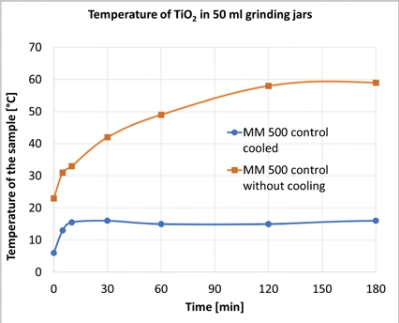
In contrast to classic planetary ball mills, the MM 500 control produces particle sizes in the nanometer range without the need for cooling breaks, as the oscillating grinding jar movement generates less heat than the circular movement of the grinding jars in planetary ball mills. In addition, the various cooling options have a positive effect. The application example in Figure 4 (left) shows that during the grinding of titanium dioxide, the temperature in the 50 ml grinding jars of the MM 500 control was stabilized below 20°C by connecting a chiller with 4°C cold water. Without this cooling, the sample temperature settled at 60°C. The viscosity had to be readjusted twice in the course of the three-hour grinding, but only once with cooling. In both cases, no cooling breaks were programmed, and the grinding process could be reduced to a minimum.
Compared to the RETSCH high energy ball mill Emax, which can also be cooled with 4°C cold water, grinding in the MM 500 control takes longer. The Emax is still the fastest ball mill on the market, here the finest grind size is achieved after only 30 min (Figure 4, right). The Emax was also operated continuously, without cooling breaks. However, due to the very high energy input at 2000 rpm, the sample temperature settled at similar values despite cooling as the sample temperature in the MM 500 control without cooling (values not shown in the figure). In the Emax, the viscosity - on the one hand because of the very efficient grinding, on the other hand because of the higher temperature - must be checked and adjusted more frequently in between.
Particle size and temperature during wet grinding of titanium dioxide with 0.1 mm grinding balls made of zirconium oxide; left side: With external water cooling, the temperature of the sample in the MM 500 control could be constantly stabilized below 20°C, this is 60°C without cooling, similar values are achieved during grinding in the Emax with 4°C water cooling (values not shown). Right side: the MM 500 control was operated continuously for 3 h, therefore the total process time is equal to the net grinding time, the final fineness achieved was 0.25 μm. The best possible fineness was achieved in Emax already after 30 min of continuous grinding.
Optimal conditions for mechanochemical processes
The mechanical effects achieved in a mixer mill can also be used very well in so-called mechanochemistry or mechanosynthesis. The impact of the grinding balls on the wall of the grinding jars and between the grinding balls provides the activation energy required for the chemical reactions. In this way, complex chemical reactions can be carried out in an environmentally friendly manner without the use of solvents. The reaction types are very diverse, ranging from oxidative halogenation or Diels-Alder reactions to enamine formation, syntheses of glycosides or even simple regioselective reactions. Sometimes reactions succeed in mechanosynthesis that do not succeed in classical chemistry, where they are initiated by an external heat source, for example. If, in addition, the temperature in the reaction can be truly controlled, as is now possible with the MM 500 control and the cryoPad, the range of viable reactions expands significantly.
Reactions that proceed via several thermally unstable intermediates can now be much better controlled by synthesizing them while simultaneously cooling them to, for example, -10°C. The thermally unstable intermediates can be stabilized and in total their yield is increased. The temperature control of the MM 500 control enables completely new reactions. This is shown by the example of the synthesis of ZIF-8 from 2-methylimidazolium and zinc oxide . The MM 500 control allows very good control over which products can be generated in a mechanosynthesis by using different temperature levels.
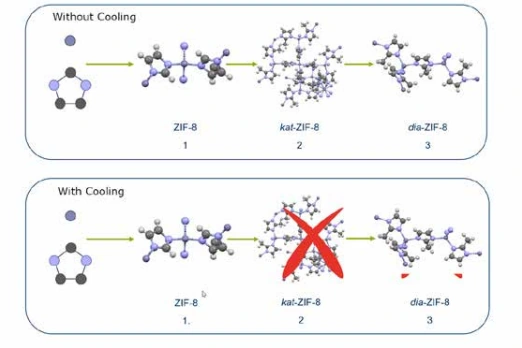
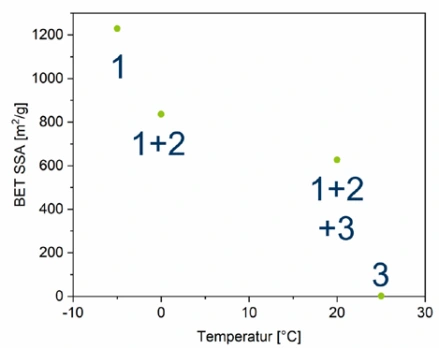
The further reaction to kat-Zif-8 and dia-ZIF-8 could be stopped as soon as the temperature of the thermal plates was set to -5 °C by means of a chiller. An increase by 5 °C still led to the formation of the second intermediate kat-ZIF-8. At 20 °C of the thermal plates, all three products were found; when synthesizing without cooling, the actual reaction is completed, only dia-ZIF-8 remains. Reaction scheme and performance of the experiments: Dr. Sven Grätz, Ruhr-University Bochum, Faculty of Chemistry and Biochemistry, AG Prof. Borchardt
Since chemical reactions in the MM 500 control can also be stabilized in other temperature ranges up to +100°C by connecting it to a chiller or cryostat (see Steady-state adjustment of temperature during grinding), this mill offers abundant possibilities for exploring novel synthesis routes and products. For example, there are reaction pathways such as the Suzuki- Miyaura cross-coupling reaction1, where a higher temperature accelerates the reaction, similar to classical chemistry using Bunsen burners. The MM 500 control offers many advantages for such reactions.
Cryogenic grinding of tough, elastic or fatty samples
Mixer mills such as the MM 400 or the CryoMill from RETSCH are the mills of choice for pulverizing tough, elastic sample materials such as tire rubber, polypropylene or other types of plastic. Pulverization of these materials is not possible at room temperature. After embrittlement with liquid nitrogen, the samples are brittle enough to be homogenized in ball mills. For this purpose, the sample and grinding balls are filled into the grinding jar, which is then tightly closed for indirect embrittlement of the sample. In the case of the MM 400, the jars are placed in a bath with LN2 for a few minutes and are then clamped in the mill. RETSCH offers the CryoMill especially for such cryogenic grinding processes. The advantage here is the continuous indirect embrittlement of the sample at -196°C. Due to the constant low temperature, a higher fineness can often be achieved than in the MM 400. A connected autofill tank makes operation much easier and safer, as no open bath with liquid nitrogen is required. In addition, a grinding jar made of zirconium oxide is available for heavy metalfree grinding.
The clear advantage of the MM 500 control over classic mixer mills is the regulated and safe cryogenic operation in combination with the cryoPad and a 150 l liquid nitrogen tank. As with the CryoMill, the user does not come into contact with LN2 at any time. The thermal plates can be controlled at temperatures down to -100°C, for example, and it is also possible to set an additional cooling time. Cryogenic grinding for more than 2 min is more effective if it is interrupted by cooling breaks to dissipate the heat in the grinding jar. For this purpose, the grinding jar must be removed from the MM 400 and reimmersed into the LN2 bath. In the MM 500 control, there is no need to remove the grinding jar; cooling breaks can be easily programmed in the form of grinding cycles. The CryoMill offers the advantage of achieving lower temperatures, which are indispensable for grinding certain types of plastic. In general, the finest grind sizes are achieved in the CryoMill.
However, the MM 500 control also has advantages over this model: With two grinding jars up to max. 125 ml instead of 1 x 50 ml, the sample throughput can be increased to 2.5 times. Due to the special type of cooling by means of thermal plates and the temperature limitation to a maximum of -100°C instead of -196°C, the MM 500 control allows the use of all grinding jar materials, i.e. also zirconium oxide, for cryogenic grinding. This enables heavy metal-free grinding of larger sample quantities. Grinding jars made of tungsten carbide for cryogenic grinding are unique and allow neutral-to-analysis grinding with a higher energy input due to the higher density of this material compared to steel, which is advantageous for harder samples.
Kubota, Ito et al., Tackling Solubility Issues in Organic Synthesis: Solid-State Cross-Coupling
1 of Insoluble Aryl Halides. Journal of the American Chemical Society, March 30, 2021. DOI:10.1021/ jacs.1c00906; Tackling Solubility Issues in Organic Synthesis: Solid-State Cross-Coupling of Insoluble Aryl Halides
Comparison of different mixer mills with regard to cryogenic grinding
| Parameter | MM 400 | MM 500 control | CryoMill |
|---|---|---|---|
| Temperature control | no | yes | yes |
| Temperature shown in the display | no | yes | no |
| Various temperatures | no | yes | no |
| Connectivity to | - | CryoPad, Chiller, Cryostat | LN tank 2 |
| Max. sample volume | 2 x 20 ml | 2 x 40 ml | 1 x 20 ml |
| Autofill with LN 2 | no | yes | yes |
| Materials of grinding jars for croygenic grinding | Steel | Steel, zirconium oxide, tungsten carbide | Steel, zirconium oxide |
| Fineness at maximum cooling | + | + | ++ |
| Grinding in cycles | Manual | Up to 99 | Up to 9 |
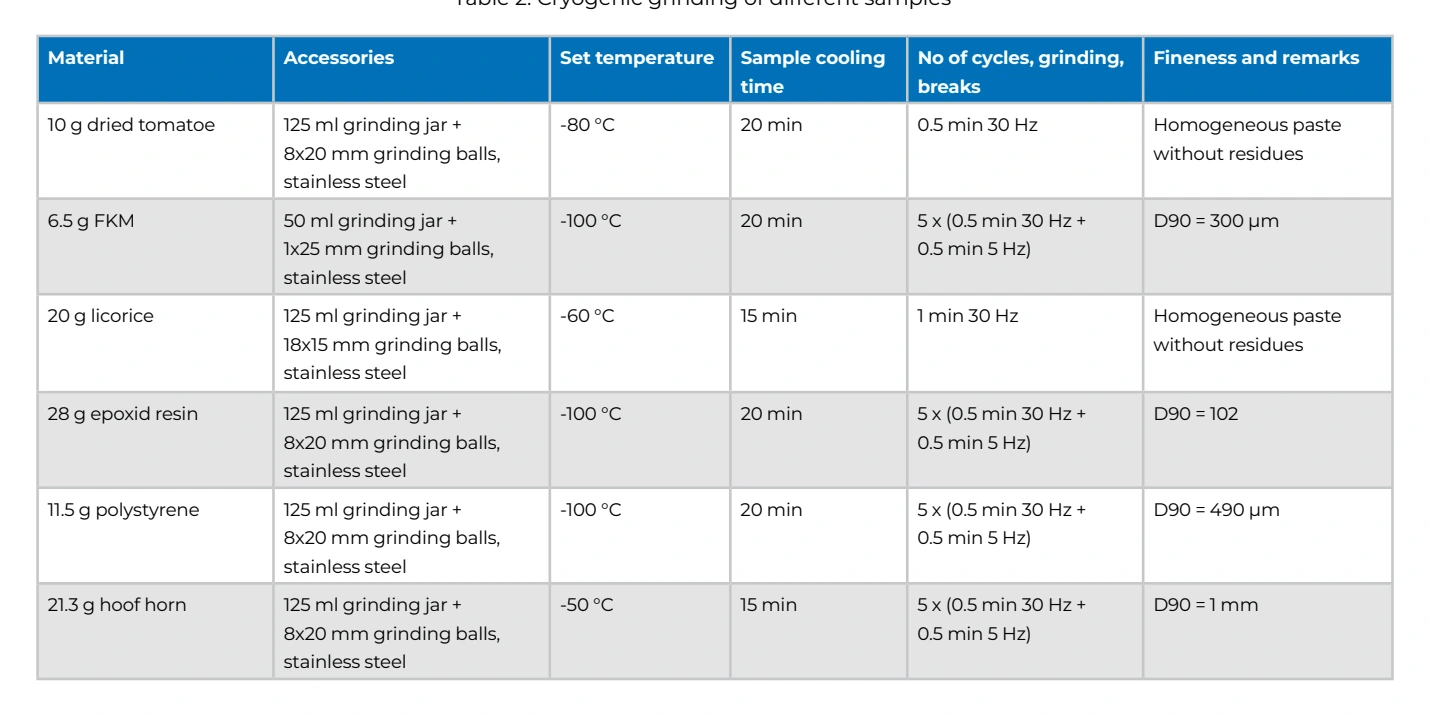
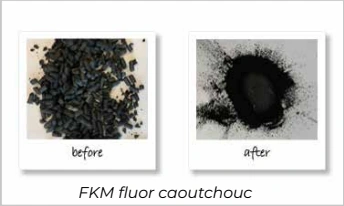
The MM 500 control is therefore ideal for homogenizing samples that do not require the very extreme cryogenic conditions, but can be pulverized by cooling them down to -100°C. This applies to plastic materials such as FKM, or food samples such as dried tomatoes, gummy bears or fatty meat and sausages. Table 2 uses these examples to show how complete homogenization, which cannot be achieved at room temperature, is effortlessly achieved in the MM 500 control. In addition, volatile ingredients or temperature-unstable substances are preserved and remain chemically unchanged by cooling.
Cryogenic grinding of different samples
| Material | Accessories | Set temperature | Sample cooling time | No of cycles, grinding, breaks | Fineness and remarks |
|---|---|---|---|---|---|
| 10 g dried tomatoe | 125 ml grinding jar + 8x20 mm grinding balls, stainless steel | -80 °C | 20 min | 0.5 min 30 Hz | Homogeneous paste without residues |
| 6.5 g FKM | 50 ml grinding jar + 1x25 mm grinding balls, stainless steel | -100 °C | 20 min | 5 x (0.5 min 30 Hz + 0.5 min 5 Hz) | D90 = 300 µm |
| 20 g licorice | 125 ml grinding jar + 18x15 mm grinding balls, stainless steel | -60 °C | 15 min | 1 min 30 Hz | Homogeneous paste without residues |
| 28 g epoxid resin | 125 ml grinding jar + 8x20 mm grinding balls, stainless steel | -100 °C | 20 min | 5 x (0.5 min 30 Hz + 0.5 min 5 Hz) | D90 = 102 (unit not specified) |
| 11.5 g polystyrene | 125 ml grinding jar + 8x20 mm grinding balls, stainless steel | -100 °C | 20 min | 5 x (0.5 min 30 Hz + 0.5 min 5 Hz) | D90 = 490 µm |
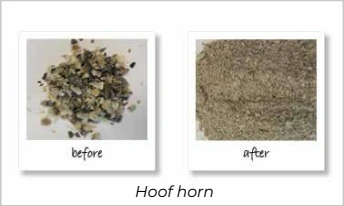
| 21.3 g hoof horn | 125 ml grinding jar + 8x20 mm grinding balls, stainless steel | -50 °C | 15 min | 5 x (0.5 min 30 Hz + 0.5 min 5 Hz) | D90 = 1 mm |
Safe and easy handling
The MM 500 control offers maximum operating convenience. The lids are securely and easily screwed onto the grinding jars and are absolutely pressure-tight up to 5 bar, which is important, for example, for carrying out wet grinding or mechanochemical reactions. The proven design of the Screw-Lock grinding jars allows optimum exploitation of the jar volume. This is advantageous compared to the grinding jars of classic mixer mills, where part of the grinding jar volume is in the lid, making it difficult to achieve a ball filling of 60% used for wet grinding. The grinding jar clamping system of the MM 500 control is very userfriendly, especially compared to the system of planetary ball mills. The grinding jars are simply inserted into the grinding station and can even remain clamped in the station for interim sampling or viscosity testing. Another advantage of the MM 500 control is the large 4.3-inch touch display for convenient setting of all grinding parameters, including cooling breaks if necessary. Long-term grinding up to 99 h is possible without any problems, which is especially advantageous for nanogrinding or mechanical syntheses.
Conclusion
The Mixer Mill MM 500 control is the perfect mill for temperature-monitored or temperature-controlled processes. Its simple operation and great flexibility to cool or heat samples with different temperature control media make it ideal for cryogenic grinding down to -100°C, for research and development, for preservation of temperature-sensitive analytes and much more.
Plan the configuration for your material.
Define the intended thermal conditions and how they relate to the sample. A plate reading, a selected condition and the temperature inside a sample are not identical observations. Discuss thermal services, vessel contact and cycle settings together when selecting the preparation configuration.
| Consideration | Information to provide |
|---|---|
| Thermal task | Monitor, cool or establish a range |
| System arrangement | Jar and thermal supply |
| Verification | Relationship to the prepared sample |
How should the application examples be used?
The results describe the materials and configurations discussed here. Confirm equipment options, contact materials and operating conditions for your own sample before adopting a method. A demonstrated endpoint does not guarantee the same outcome for a different material.
Discuss material testing with Glen Mills or request further information or a quote.
Explore the equipment discussed
- RETSCH MM 500 control Mixer Mill
- RETSCH CryoMill Cryogenic Mixer Mill
- RETSCH Emax High Energy Ball Mill
- RETSCH MM 400 Mixer Mill