
What should a laboratory compare when changing its workflow?
Compare repeatability, recovered mass, handling steps and documentation on the same powder. A faster sequence alone does not demonstrate an equivalent analytical method.
ILM MEDIA
All-in-one – reliable particle analysis without sample transfer
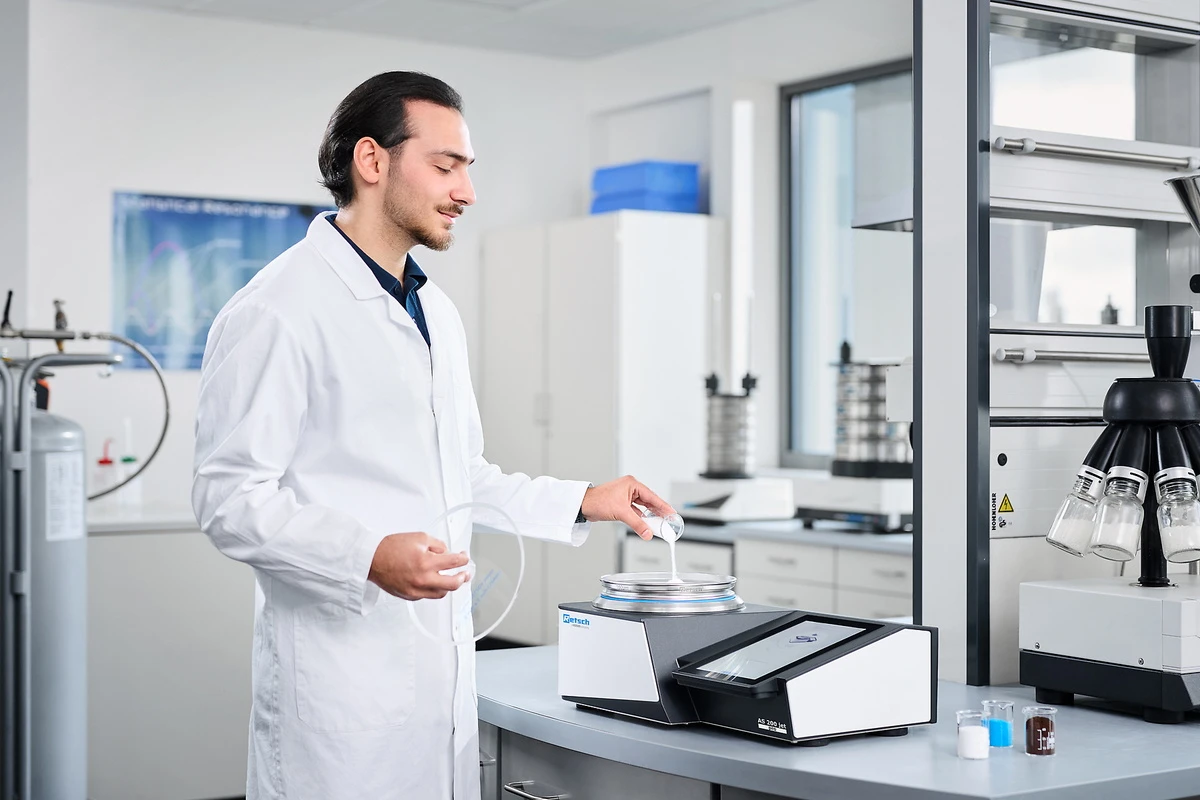
In particle analysis, transferring samples between the sieving machine and an external balance has long been a signifi cant source of error. Material loss due to adhesion, or handling can compromise results and product safety. With the AS 200 jet pro and AS 200 jet pharma, Retsch eliminates this risk by combining sieving, weighing, and data evaluation in a single tabletop device. Designed for modern laboratory environments, these air jet sieving machines deliver precise, reproducible results while simplifying daily workfl ows in quality control and production.
Additional highlights include: • Optional connection of an external highprecision, pre-validated balance via USB • High-separation cyclone for collecting fi ne fractions and reducing dust fi lter load • Full LIMS compatibility
AS 200 jet pharma – Designed for GMP environments
The AS 200 jet pharma is tailored for pharmaceutical laboratories and regulated environments. It meets software validation requirements according to ISPE GAMP 5, FDA 21 CFR Part 11and EC GMP Annex 11. Integrated user management enables secure handling of access rights. Administrators can assign permissions individually or via predefi ned roles. Adjustable password parameters, legally compliant electronic signatures, and a comprehensive audit trail ensure full traceability. For optimal use of all features, network integration is recommended. IQ/OQ documentation and risk analysis support validation processes.
Determining particle size distributions with one sieve
Two established methods are available:
1. Standard method
The entire sample is placed on the fi nest sieve. After sieving and weighing, the oversize material is transferred stepwise to progressively coarser sieves until complete separation is achieved. This method requires relatively small sample quantities.
The advantage of air jet sieving
Air jet sieving is the preferred method for dry sieving of samples with a high proportion of fi ne particles and serves as a fast alternative to vibratory sieving for particle sizes up to 500 µm. Unlike other methods, air jet sieving uses only one sieve per process. While the nozzle speed is typically fi xed in conventional systems, the AS 200 jet pro and pharma offer variable speed control. Low speeds protect sensitive samples while high speeds effi ciently break up strong agglomerates. The ability to use sieves of different heights further optimises impact intensity and process duration, ensuring gentle yet effective sample processing.
2. Swiss method
The sample is divided into representative subsamples, each sieved individually with the corresponding mesh size. When properly performed, this method eliminates transferrelated errors and can deliver particularly precise results.
Conclusion
The AS 200 jet pro and AS 200 jet pharma provide tailored solutions for demanding particle size analysis in quality and production control. By integrating weighing, sieving, and evaluation into a single compact system, they eliminate transfer-related errors and prevent product losses.
All-in-one. Reliable. Designed for precision.
Guided sieving for maximum reliability
The internal software controls and documents the entire process: • Method creation • Sieve management • Parameter setting • Sieving analysis • Weighing • Data evaluation All methods and results are stored in an internal database. In the pharma version, results can be assigned to individual users and documented via a comprehensive audit trail. Users are guided step by step through the sieving process – from routine measurements to complex distribution analyses. Results can be displayed graphically or in tabular form, ensuring clarity and traceability.
Intelligent assistants and process safeguards
To further increase process reliability, the AS 200 jet pro and pharma include advanced control and monitoring functions: • Sieve-check function – A barcode scanner verifi es that the correct sieve is used for the selected method. • Plausibility test – The system detects missing sieves or lids automatically based on weight deviations. • Weighing assistant – Recommends the optimal sample quantity to ensure standardcompliant and reproducible results, and to avoid overloading or underloading. • Weigh-in tolerance – Customisable sample amount and tolerance limits (e.g., 10 g ±3%) prevent deviations from defi ned routines. • Backweigh-rolerance – Enables comparison of results with predefi ned target values. • Trend analysis of sieves – Detects wear or clogging of fi ne-mesh sieves at an early stage (e.g., in accordance with DIN 66165). • Trend analysis of sieve analyses – Facilitates batch comparison and close process monitoring. • Filter function for sieve series – Automatically adjusts recommended sieve combinations when using standardised series such as the Renard series.
Integrated precision: Weighing and sieving in one system
Traditionally, laboratory staff had to move test sieves between the air jet sieving machine and a separate balance. This workfl ow increased the likelihood of sample loss and handling errors. The AS 200 jet pro and pharma models solve this issue with a patented onboard balance integrated directly into the sieving system. Modern air jet technology ensures excellent separation of fi ne particles with minimal agglomeration. The robust, high-precision balance (readability accuracy: 0.01 g) is engineered to withstand mechanical stresses – even rubber hammer taps used to break up agglomerates during sieving. The patented all-in-one concept combines air jet sieving, weighing and automated result evaluation. By eliminating multiple sources of error and incorporating intelligent assistants and verifi cation features, the system enhances precision while saving valuable laboratory time.
Particle size analysis made easy
The AS 200 jet pro is designed for 203 mm (8”) test sieves, or 200 mm sieves with an adapter. It also supports Retsch test sieves of varying heights and mesh sizes, offering fl exibility for different applications. An externally connected industrial vacuum cleaner can be controlled via internal software, allowing precise adjustment of vacuum performance. All particle size analyses are performed using intuitive onboard software via a touchscreen interface. The result is a compact, user-friendly system that integrates all essential process steps into one device.
Plan the configuration for your material.
When comparing an integrated system with a separate balance, map the whole measurement process. Tare handling, result documentation and product-change cleaning matter alongside separation. Decide which information an operator must enter and which values the system should retain before defining a routine method.
| Consideration | Information to provide |
|---|---|
| Workflow map | Tare, sieve, weigh and evaluate |
| Data needs | Operator entries and retained results |
| Product changes | Cleaning and carryover checks |
How should the application examples be used?
The results describe the materials and configurations discussed here. Confirm equipment options, contact materials and operating conditions for your own sample before adopting a method. A demonstrated endpoint does not guarantee the same outcome for a different material.
Discuss material testing with Glen Mills or request further information or a quote.