
Should every agglomerate be broken during particle analysis?
Not necessarily. The intended measurement determines whether agglomerates are part of the product or should be dispersed before evaluating its particles.
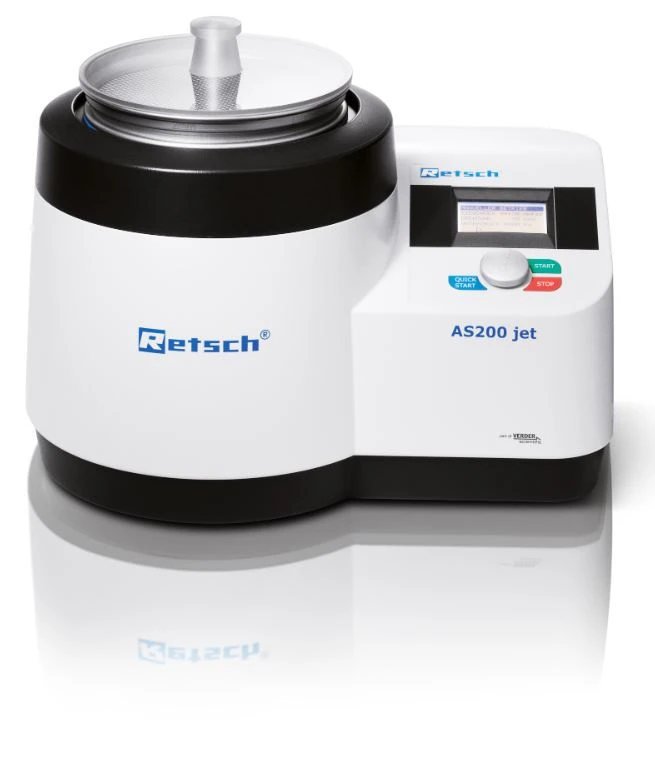
AIR JET SIEVING MACHINE AS 200 JET
Air jet sieving is usually the method of choice for dry sieving of materials with particle sizes below 40 microns. However, it is also a faster alternative to vibratory sieving of materials of up to 250 microns.
Reproducible results due to Open Mesh Function
High flexibility through adjustable nozzle speed
Operation with RETSCH sieves Ø 203 mm (8")
Automatic vacuum regulation (option)
Memory for up to 9 SOPs
Silent operation due to integrated silencer
Great flexibility
Air jet sieving is usually carried out with one sieve only. Together with the sample material the sieve is placed on the unit and covered with a lid. A powerful industrial vacuum cleaner generates a strong jet of air which disperses the particles on the sieve through the slotted nozzle rotating below the sieve mesh. Thus the particles are dispersed with each rotation and are distributed over the complete sieve surface. The jet of air causes a continuous new orientation of the particles on the sieve surface; particles with sizes smaller than the sieve apertures are sucked in by the vacuum cleaner. Optionally, a cyclone can be used to collect the sample material can in a laboratory bottle. When using sieves of 25 mm height, the inflowing air causes the particles to impact on the lid which helps to destroy agglomerates.
Depending on the material properties, a variation of the speed can improve the sieving process. Sensitive sample materials should be sieved with a low speed to minimize stress on the material which could lead to a destruction of the primary particles. Moreover, it is recommendable to use sieves of 50 mm height because the impact of the sample against the lid is less strong. For samples which tend to agglomerate, however, sieving with high speed is more effective. The impact frequency of the particles against the lid is substantially increased and even strong agglomerates are dissolved after short sieving times. It is also possible to regulate the negative pressure generated by the vacuum cleaner which allows variation of the impact speed of the particles. Due to its great flexibility with regards to sieve height, speed and negative pressure, the AS 200 jet can be adapted to suit the specific requirements of every material.
Test sieves
RETSCH high quality sieves are produced in a manufacturing process that is unique in the world.
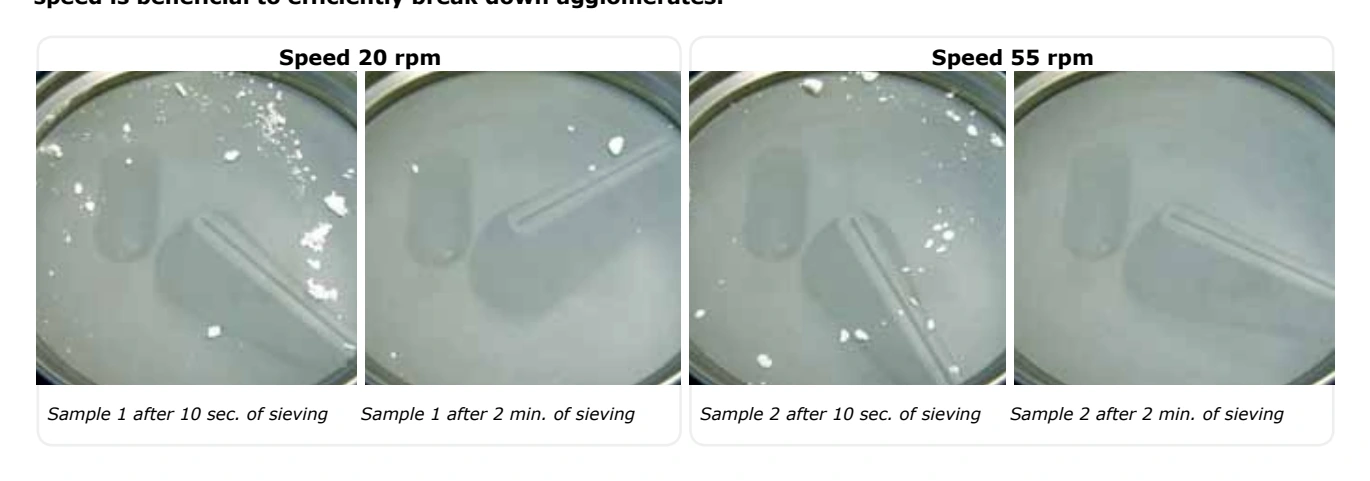
The following pictures show two samples of ZrO2 powder which were sieved at different speeds. It is evident that a high speed is beneficial to efficiently break down agglomerates.
Speed 20 rpm
Speed 55 rpm
Sample 1 after 10 sec. of sieving
Sample 1 after 2 min. of sieving
Sample 2 after 10 sec. of sieving
Sample 2 after 2 min. of sieving
Sieving parameters: Sieve: Ø 203 mm, 25 mm height acc. to ISO 3310-1, aperture size 63 µm Material: 20 g of ZrO2 powder with agglomerates Speed: 20 rpm (sample 1) and 55 rpm (sample 2) Sieving time: 10 sec. and 2 min. Negative pressure: approx. 35 kPa
Reproducibility and performance
Fine-meshed sieves are particularly susceptible to so-called near-mesh particles which block the sieve gauze. This not only has a negative effect on the sieve results but also leads to premature wear of the sieve. The open Mesh Function of the AS 200 jet has
proven to be a very helpful feature to maintain the performance of the sieve and, subsequently, the reproducibility of results and to minimize time and effort for cleaning. This function lets the nozzle move according to the principle “two steps forward, one
step back” which means the nozzle first moves forward by 20° and then backwards by 10° instead of rotating uniformly. Thus near-mesh particles are blown very effectively from the gauze as no material lying on the sieve surface obstructs the air jet.
Field experience
The company Alpha Ceramics GmbH uses the air jet sieving machine AS 200 jet in the context of the production of spray-granulated pressed powders from technical ceramics. Alpha Ceramics develops and produces well-engineered materials and products for spray granulation, pressing and fast firing technologies.
When pressed granules are compacted to components it is of great importance that the particle size distribution of the molding compound contains as little dust as possible. Therefore, spherical granules are produced from one or several raw materials with a particle size below 2 microns by spray granulation. These can be automatically filled into the mold due to their flowability, i.e.
they are “pourable”, and, in addition, during the compaction process they allow the air to escape. Insufficient venting during compacting causes compression of the enclosed air which expands when the pressed product is ejected from the mold and causes fissures in the product.
Although Alpha Ceramics has been carrying out particle size analyses of the finished spray granules for years, the interpretation of the ascertained particle size range has been a repeated cause for considering alternative methods to determine the “dust content” of the pressed granules. By introducing the air jet sieving machine AS 200 jet for quality control, the operation of the analysis instrument was
simplified as well as the interpretation of the results: If 50 g are sieved with a 45 µm sieve for 8 minutes with Open Mesh Function, at least 49 g have to remain on the sieve (which corresponds to a maximum of 2% dust content). If the percentage of fine particles is higher, the parameters of the spray drying process have to be corrected.
The evaluation of Robert Kremer, Technical Director at Alpha Ceramics, is very positive: “The introduction of this quality control measure proved to be uncomplicated and effective and, not least due to the easy handling of the instrument, was immediately accepted by all employees.”
Plan the configuration for your material.
Decide whether the measurement should describe intact agglomerates or a dispersed state. Then establish the sieve, airflow-related conditions and endpoint that fit that objective. Repeatability should be assessed alongside recovered mass and the condition of material retained on the sieve.
| Consideration | Information to provide |
|---|---|
| Agglomeration | Cohesion and desired measurement state |
| Separation setup | Sieve and airflow arrangement |
| Result checks | Retention and mass balance |
How should the application examples be used?
The results describe the materials and configurations discussed here. Confirm equipment options, contact materials and operating conditions for your own sample before adopting a method. A demonstrated endpoint does not guarantee the same outcome for a different material.
Discuss material testing with Glen Mills or request further information or a quote.