
Is air jet sieving the same as vibratory sieving?
No. Airflow drives the separation process rather than the mechanical motion of a sieve stack. Choose and validate the method around the powder and measurement objective.
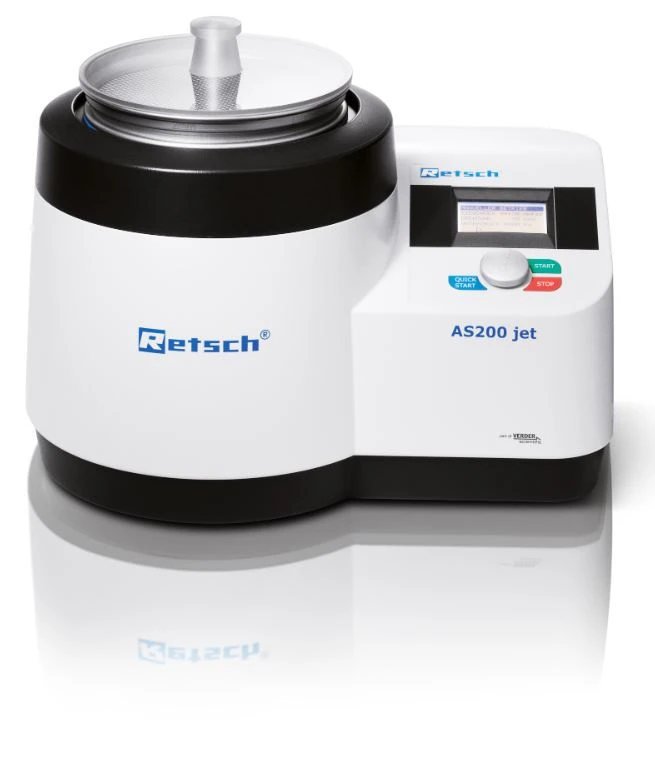
RETSCH presents the new Air Jet Sieving Machine AS 200 jet
Particle size analysis and particle size distribution are important criteria for the quality control of bulk materials. In a running production process, the results of a quality check must be available quickly to allow for immediate adjustment of the production parameters. Depending on the expected particle size and sample volume, different sieving methods and sieving machines are suitable for analysis. The method used for particle size analysis is primarily determined by the fineness of the material to be sieved. The classic methods of sieving bulk goods with vibratory, horizontal or tap sieve shakers are limited to sizes above 40 microns. When using
Air Jet Sieving Machine AS 200 jet by RETSCH
vibratory sieve shakers for wet sieving, it is possible to push the limit to 20 microns. However, this method involves dispersion of the sample in liquid, filtration after sieving, drying and finally weighing the obtained fractions.
The Principle of Air Jet Sieving
For dry sieving of samples with particle sizes below 40 microns, air jet sieving is the method of choice. It can also be a faster alternative to vibratory sieving for particle sizes up to 200 microns . All methods mentioned here are suitable for determining the particle size (sieve fraction) as well as the
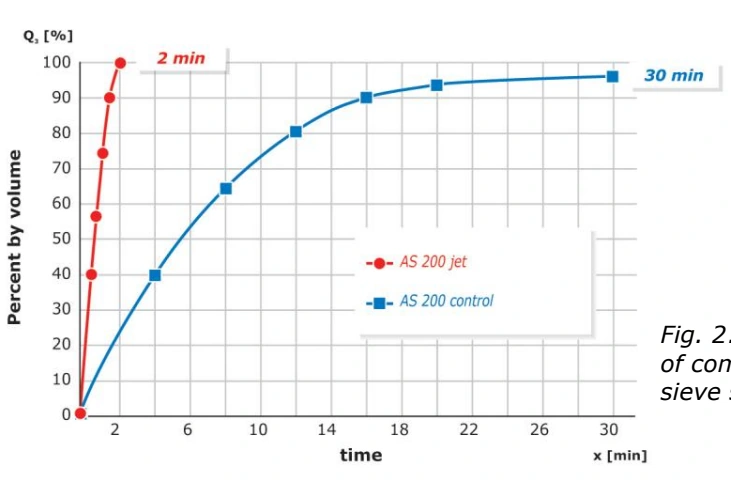
Comparison of sieving times of commercial flour with vibratory sieve shaker and air jet sieve
particle size distribution of a sample. In contrast to other methods, air jet sieving is usually carried out with one sieve only. Together with the sample material the sieve is placed on the unit and covered with a lid. A powerful industrial vacuum cleaner generates a strong jet of air which disperses the particles on the sieve through the slotted nozzle rotating below the sieve mesh. Thus the particles are dispersed with each rotation and are distributed over the complete sieve surface. Now two effects occur:
The jet of air causes a continuous new orientation of the particles on the sieve surface. Particles with sizes smaller than the sieve apertures are sucked in by the vacuum cleaner.
- When using sieves of 25 mm height, the inflowing air causes the
particles to impact on the lid which helps to destroy agglomerates.
The speed of the nozzle which rotates below the sieve is usually fixed. However, a variation of the speed, as offered by RETSCH’s AS 200 jet, can be very helpful. Sensitive sample materials, for example, should be sieved with a low speed to minimize stress on the material. This can be further reduced by using a sieve of 50 mm height because the impact of the sample against the lid is less strong. For samples which tend to agglomerate, sieving with high speed is more effective. The impact frequency of the particles against the lid is substantially increased and even strong agglomerates are dissolved after short sieving times.
Application Example
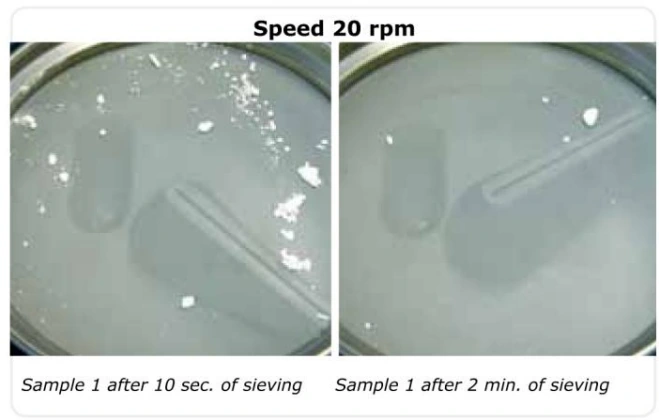
Two identical samples of ZrO2 powder were sieved with RETSCH’s AS 200 jet at different speeds (fig. 3 + 4). The parameters:
- sieve: diameter 203 mm, 25 mm height acc. to ISO 3310-1, aperture
size 63 µm
- material: 20 g of ZrO2 powder with agglomerates - speed: 20 rpm (sample 1) and 55 rpm (sample 2) - sieving time: 10 sec. and 2 min. - negative pressure: approx. 3.500 Pa
Figures 3 + 4 clearly show that a high speed is beneficial to break down agglomerates. It is also possible to regulate the negative pressure generated by the vacuum cleaner which allows variation of the impact speed of the particles. This, together with the selection of the sieve height, greatly improves sieving of sensitive materials.
Reproducibility and Performance
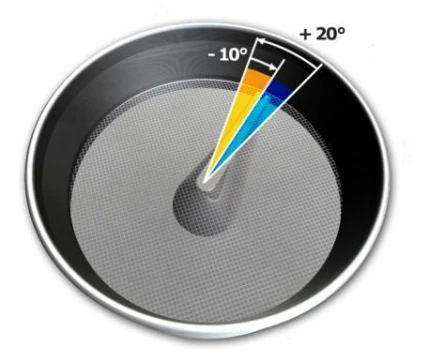
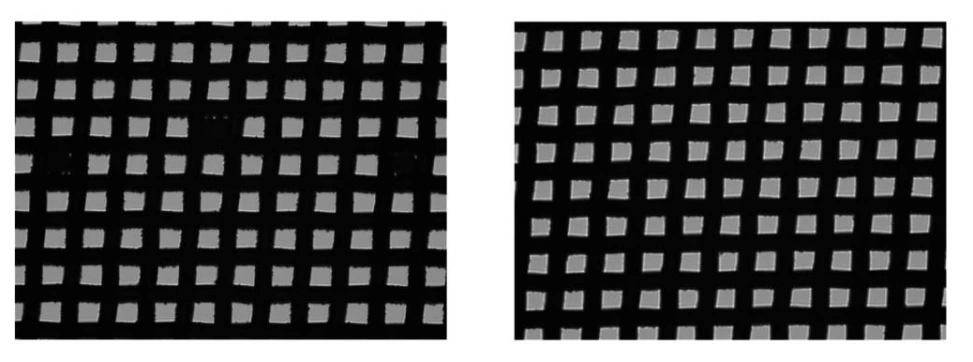
Fine-meshed sieves are particularly susceptible to so-called near-mesh particles which block the sieve gauze. This not only has a negative effect on the sieving results but also leads to premature wear of the sieve. The Open Mesh Function of the AS 200 jet has proven to be a very helpful feature to maintain the performance of the sieve and, subsequently, the reproducibility of results and to minimize time and effort for cleaning. This function lets the nozzle move according to the principle “two steps forward, one step back” which means the nozzle first moves forward by 20° and then backwards by 10° instead of rotating uniformly . Thus near-mesh particles
are blown
very
effectively from the gauze as no material lying on the sieve surface obstructs the air jet.
The comparison shows the gauze of a 45 micron sieve after sieving quartz sand with and without Open Mesh Function. It is clearly visible that some sieve apertures are blocked with particles where the sieving was done without the Open Mesh Function whereas it is completely free where the OMF was activated. By gently cleaning the sieve, this special feature helps to improve
the reproducibility of the sieve analysis as well as the lifetime of the sieves, compared to other air jet sieving machines.
Particle Size Distributions
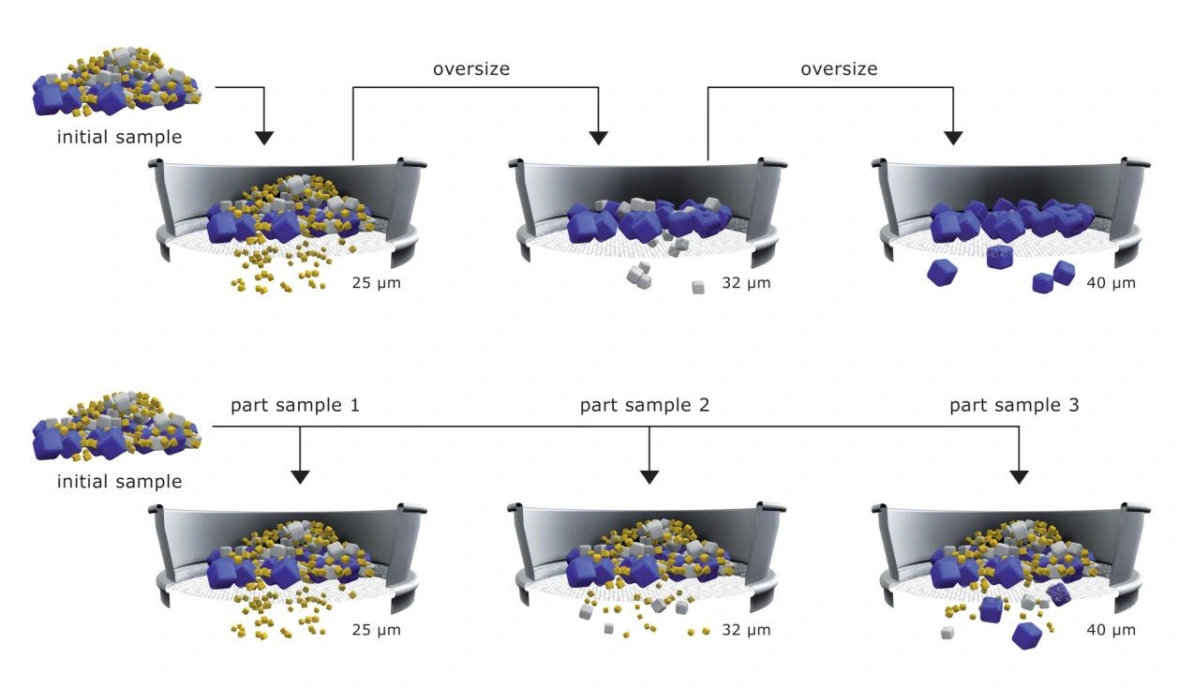
Although only one sieve can be used with the air jet sieving machine, it is still possible to determine particle size distributions with this unit. Two different methods can be used for this:
- Standard method
The complete amount of material to be sieved is placed on the sieve with the finest mesh size. After sieving and weighing the fraction, the oversize is placed on the next larger sieve and sieved again. This procedure is continued until the complete sample is separated into fractions “Swiss Method” The sample is first divided into the number of size classes to be determined and then each part is sieved individually with the corresponding sieve . This method can only provide reliable results if the sample division was carried out representatively to keep the particle size distribution in all part samples identical. The best results are obtained by rotary sample dividers, such as RETSCH’s PT 100, which divide the initial material into 6, 8 or 10 identical part samples.
For the standard method, less sample material is required, whereas the Swiss method is more exact. Software-based evaluation not only facilitates and accelerates the data processing, it also eliminates user errors during data transfer and calculation. The software (e.g. RETSCH’s EasySieve®) guides the user through the whole sieving process. It controls the sieve shaker and reads the weighing data to generate a protocol in accordance with standards.
Summary
Air jet sieving is an important method of quality control of fine bulk goods. Modern technologies and the possible variations of sieving parameters in combination with reliable evaluation software ensure reproducible sieving results over a long period of time.
Plan the configuration for your material.
Start with the size fraction that needs to be measured and the material's response to airflow. Agglomerates may behave differently from primary particles. Sample division, sieve selection and a consistent endpoint all influence whether results can be compared between batches.
| Consideration | Information to provide |
|---|---|
| Target fraction | Required separation size |
| Powder condition | Dryness, cohesion and agglomerates |
| Endpoint | Time and repeatability criteria |
How should the application examples be used?
The results describe the materials and configurations discussed here. Confirm equipment options, contact materials and operating conditions for your own sample before adopting a method. A demonstrated endpoint does not guarantee the same outcome for a different material.
Discuss material testing with Glen Mills or request further information or a quote.