
Can higher collection capacity alone improve recovery?
Not necessarily. The full flow path, particle behavior and configuration determine where material is collected or retained.
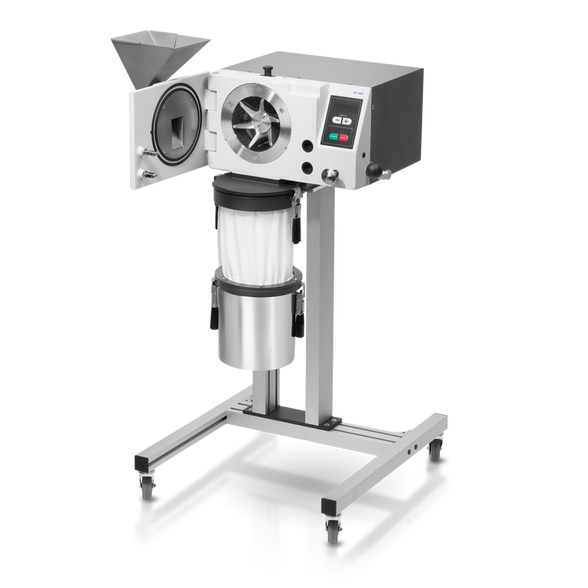
In the grinding and milling of sample materials, the complete and reproducible recovery of the sample is of critical importance. Cyclones are used to minimize sample loss (due to fine particles sticking to the grinding chamber, grinding tools, and connections), thereby ensuring clean and efficient sample recovery. At the same time, the generated airflow provides effective cooling of the sample material and protects the machine bearings from dust exposure.
In addition to the proven standard cyclone, a newly developed high performance cyclone is available, specifically designed for demanding applications in milling or sieving with fine meshes and lightweight sample materials. The aim of the investigations described here was to systematically evaluate the practical benefits of this high performance cyclone in comparison to the standard cyclone and to derive clear recommendations for users.
Set including high performance cyclone with sample bottles and holder, FDA-certified connecting hose, cover with vacuum cleaner connection and sample outlet
The tests were conducted using the Ultra Centrifugal Mill ZM 300, the Rotor Beater Mill SR 300, and the Cutting Mill SM 300, and included various sample types, sieve sizes, and operating parameters.
Ultra Centrifugal Mill ZM 300
Rotor Beater Mill SR 300
Cutting Mill SM 300
Overview of experiments and objectives
The influence of the cyclone type on sample recovery was investigated for:
Different mill types Varying sieve sizes (< 0.12 mm to 0.75 mm) Samples with significantly different bulk density and particle morphology
The focus was not on absolute grinding performance, but explicitly on a comparative evaluation of the recovery rates between the standard cyclone and the high performance cyclone under application-oriented, practical conditions.
When is a high performance cyclone useful?
The tests demonstrate that the differences between the standard cyclone and the high performance cyclone depend heavily on the mill used, the sieve size, and the type of sample.
Results on the ZM 300
With the ZM 300, very similar recovery values are achieved for both cyclone types, especially when using a 0.5 mm or coarser sieve. In these applications, the high performation cyclone offers no significant advantage over the standard cyclone. But there's a clearer difference with finer sieves, for instance when grinding wood with a 0.25 mm sieve. Here, the high performance cyclone tends to deliver better results: while recovery rates of around 90% were achieved with the standard cyclone, the high performance cyclone achieved almost complete recovery (≈100%). For less lightweight sample types such as chicken feed, the difference between the two cyclones was smaller, although very high recovery rates were achieved with both overall.
Conclusion for the ZM 300:
The high performance cyclone offers added value, especially with fine sieves (<0.5 mm) and lighter samples. The effect is minimal in standard applications with 0.5 mm sieves or coarser.
Results on the SR 300
When using the SR 300, differences between the standard cyclone and the high performance cyclone become already clearly visible with the 0.5 mm sieve. Across all tests performed, the high performance cyclone consistently delivered 2–5 % higher material recovery rate, demonstrating its superior separation performance compared to the standard cyclone. The performance difference became even more pronounced when using a 0.25 mm sieve. In this configuration, the high performance cyclone achieved a 10–13% higher material recovery than the standard cyclone, clearly emphasizing the efficiency advantage of the high performance design.
Conclusion for the SR 300:
The high performance cyclone represents a clear functional advantage, particularly when working with fine sieves and sensitive sample material. Overall, the SR 300 benefits most significantly from the use of the high performance cyclone.
Results on the SM 300
When processing pre-shredded straw with the SM 300, the performance gap between the cyclone types was initially moderate, with the high performance cyclone delivering around 4% higher material recovery. More significant effects were observed, especially when processing very light samples, such as feathers. Here, the high performance cyclone achieved up to 25% higher recovery rates. In all tests, the high performance cyclone performed better than the standard cyclone. The tests were carried out using 0.5 mm and 0.25 mm sieves. The results indicate that the described effects are particularly pronounced at 0.5 mm sieves and smaller, as differences in separation efficiency become especially evident in this fine particle size range.
Conclusion for the SM 300:
For light, voluminous, or fibrous samples, the high performance cyclone is highly recommended, especially in combination with fine sieves.
KEY TAKEAWAYS
Based on the test results, the following general guidelines can be established: The lighter the sample material (e.g., feathers), the more pronounced the performance advantage of the high performance cyclone over the standard cyclone. The smaller the sieve used, the more significant the differences between the two cyclones. Compared to the other models, the SR 300 shows the strongest dependence on the type of cyclone used and benefits particularly from the high performance cyclone..
Notes:
In coarse size reduction applications - for example with jaw crushers, hammer mills, or the SK 300 cross beater mill - only minimal performance differences are expected, as cyclone influence plays a less significant role in these processes.
Plan the configuration for your material.
Compare supported cyclone arrangements on the actual material, including residues in the chamber, tubing and receiver. Airflow may affect both discharge and the thermal conditions of preparation. Use a consistent mass balance to assess whether the collected portion represents what was introduced.
| Consideration | Information to provide |
|---|---|
| System compatibility | Mill and complete connection set |
| Residue checks | Chamber, tube and receiver |
| Trial comparison | Recovered mass and sample condition |
How should the application examples be used?
The results describe the materials and configurations discussed here. Confirm equipment options, contact materials and operating conditions for your own sample before adopting a method. A demonstrated endpoint does not guarantee the same outcome for a different material.
Discuss material testing with Glen Mills or request further information or a quote.
Explore the equipment discussed
- RETSCH SR 300 Rotor Beater Mill
- RETSCH SM 300 Cutting Mill
- RETSCH ZM 300 Ultra Centrifugal Mill
- RETSCH SK 300 Cross Beater Mill