
Does a cyclone guarantee that no sample is lost?
No. Recovery depends on the full arrangement and material. Evaluate retained residues and the collected portion under the intended operating conditions.
Cyclone separators deliver substantial benefits when used with mills in laboratory settings. While cutting mills or rotor mills are already frequently operated with a cyclone, also jaw crushers and disc mills benefit greatly from this setup. By using a cyclone, it is even possible to combine two mills directly: for example, a two-stage grinding process with a jaw crusher and a disc mill can be completed in a single step.
How does a cyclone work?
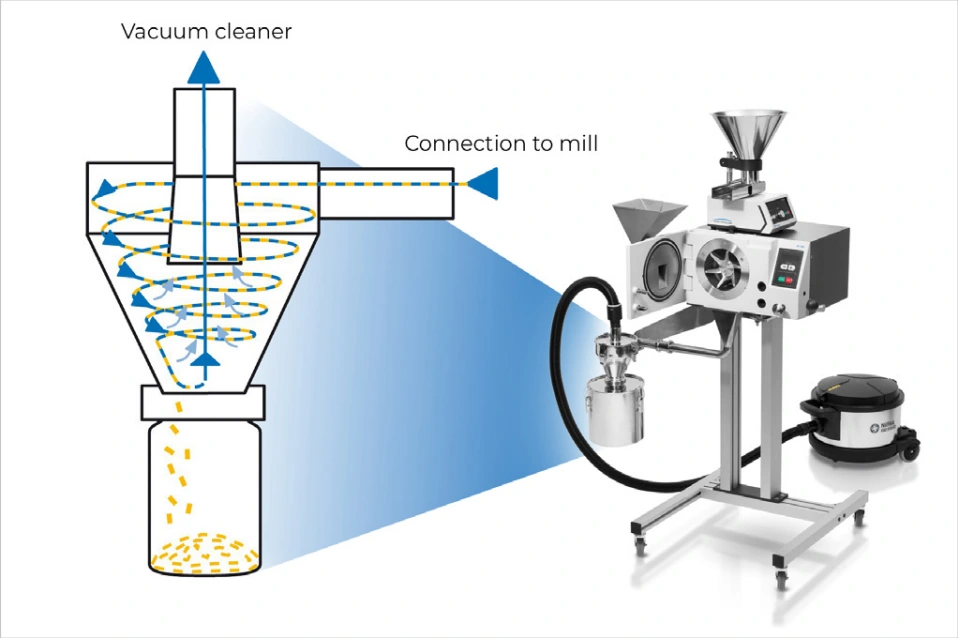
A cyclone separator is connected to the mill outlet, a vacuum system, and a collection receptacle. The vacuum draws the air-particle mixture from the grinding chamber into the cyclone, where it enters tangentially and begins to spiral. Centrifugal forces push the heavier particles outward, causing them to fall into the connected collection receptacle, while the cleaned air exits through the top. The functional principle is illustrated in Figure 1.
Reasons for using a cyclone separator
A cyclone separator ensures efficient transfer of sample material from the grinding chamber to the collection receptacle. This results in less dust emission and cleaner processes, which are reflected in the following practical advantages:
Time and cost efficiency: Minimal cleaning effort and longer lifetime of the mill when operating in a low-dust environment.
Maximum sample recovery: Less residue, ensuring even small sample quantities and fine particles can be reliably recovered.
Safe working environment: Significantly reduced dust exposure creates a clean and healthy laboratory environment.
Safe sample preparation of temperature-sensitive materials: Reduced heat buildup in
the grinding chamber – especially for milling setups using fine sieves or for samples that change their properties when exposed to heat.
Flexibility in placement of collection receptacle and receptacle size: Cyclone-operated
sample transport accommodates collection receptacle volumes from 250 ml glass containers up to 30 l receptacles with Retsch systems. The positioning of the receptacle is unrestricted, providing maximum adaptability.
Which factors should I consider when selecting a cyclone system?
Retsch offers a cyclone solution for every application. Cyclones are available in numerous variants and can be flexibly adapted to different requirements.
1. Different variants
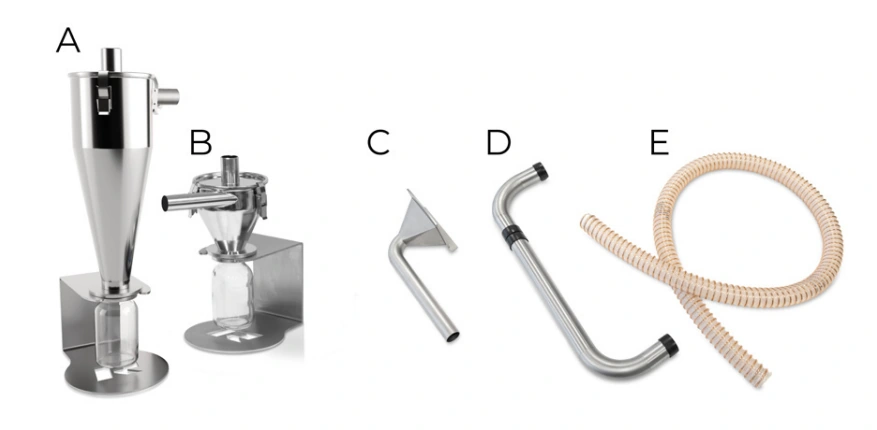
The Cutting Mill SM 50 and the Twister feature a particularly compact model, perfectly tailored to the sample flows generated in these mills. For other mills, the selection of the cyclone depends on the application. Either the high-efficiency variant (A) for maximum recovery or the standard version (B) can be chosen. The cyclone variants are shown in Figure 2.
2. Flexible mounting options
Whether mounted directly on the machine frame, on a stable stand on the laboratory bench, or as an attachment with a hose connection to the collection container, there is a suitable solution for every laboratory environment. FDA-compliant hoses, rigid piping, or flexibly adjustable connections are all available C, D and E.
For which industries are cyclone separators suitable?
The cyclone separator is suitable for a wide range of sample types and is used across various industries. It has proven particularly effective with dusty or slightly sticky materials that can adhere to mill surfaces. Limitations arise with very heavy or very light particles, or when too much sample is fed at once so that the sample material cannot be transported or separated efficiently. Typical applications include the food and chemical industries, environmental analysis, mining, agriculture, materials research, the pharmaceutical industry, and recycling. Some examples are provided below.
1. Crushing of paint chips with the Ultra-Centrifugal Mill ZM 300
The use of the cyclone prevents the sample from being heated up during the grinding.
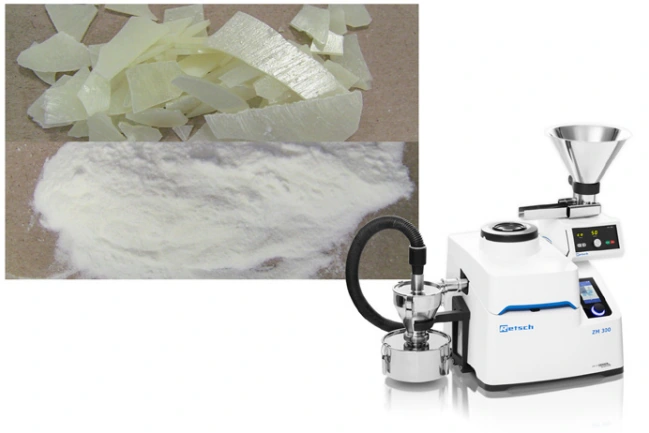
0.2 mm distance sieve, stainless steel 20,000 rpm Feed size: 20 mm Final fineness: 200 µm 250 g / 3 min
2. Crushing of cannabis with the Cutting Mill SM 300 Food Grade
The use of the cyclone unit minimizes material residues from sticky grinding materials on the mill and related surfaces, ensuring clean and efficient sample discharge.
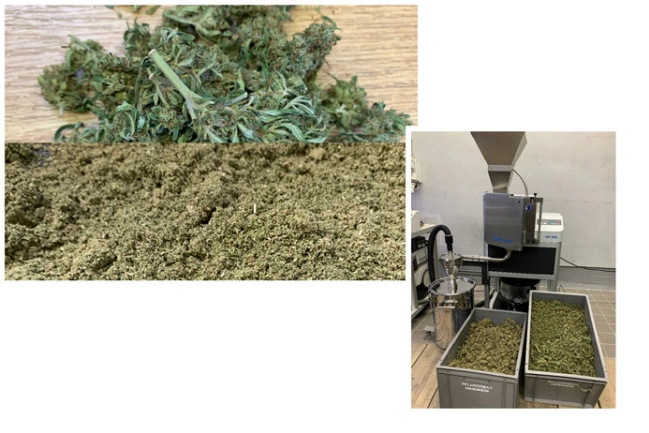
4 mm bottom sieve, 316L stainless steel 2,000 rpm Feed size: 60 mm Final fineness: 4 mm 40 kg / h
3. Crushing single pieces of roots in the Cutting Mill SM 50
Thanks to the cyclone unit, sample discharge is maximised even with very small sample quantities.
Standard milling chamber with integrated cyclone 4 mm bottom sieve, stainless steel 4,000 rpm Feed size: 50 mm Final fineness: 5 mm 1 piece / min
4. Crushing of bitumen in the Jaw Crusher BB 250
The cyclone prevents dust from escaping, contributing to a safe working environment and increasing the service life of both the bearings and the entire machine.
Breaking jaws of manganese steel Wearing plates of hardened steel 2 mm gap size Feed size: 30 mm Final fineness: 5 mm 1 kg / 5 min
5. Sieving of pharmaceutical powder in the Air Jet Sieving Machine AS 200 jet pro
The cyclone enables reliable collection of the screened fraction.
Test Sieve, ISO 3310/1, 200x50mm, 45µm, stainless steel, with compliance certificate Speed: 55 rpm 90 % < 45 µm 30 g / 3 min
6. Crushing of biochar in the Hammer Mill HM 200
The cyclone allows a collection receptacle with a volume of 30 litres to be used, which makes it possible to process larger sample quantities.
2 mm bottom sieve, stainless steel Feed size: 10 mm Final fineness: 2 mm 1 kg / min
7. Combination units for maximum efficiency
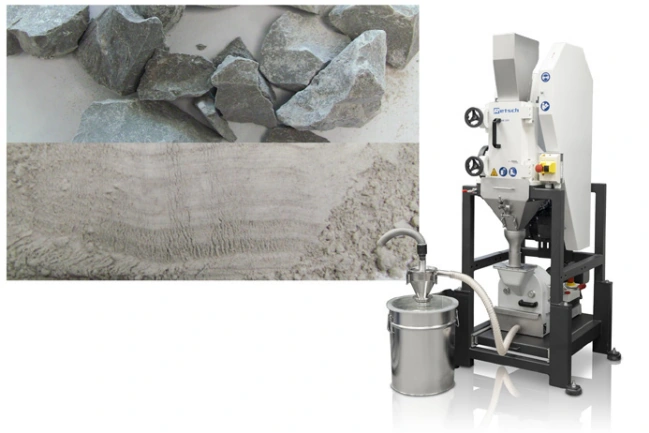
Preparing fine particles - for example, for analysis - from large pieces of hard and brittle material typically involves two separate steps using a jaw crusher followed by a disc mill. By integrating a cyclone separator, these processes can be combined into a single, automated operation. The cyclone enables direct and reliable material transport from the jaw crusher to the disk mill, allowing samples with feed particle sizes up to 60 mm to be ground in one pass to final fineness of up to 200 μm, as shown in Figure 3. This setup eliminates the need for manual sample transfer and additionally prevents dust from escaping the mills. It is especially effective when no sample splitting is required, providing a streamlined solution for applications in agriculture, cement production, mining, precious metal analysis, materials research, and environmental analysis.
Gap setting jaw crusher: 2 mm Gap setting disc mill: 0.2 mm Feed size: 60 mm Final fineness: 200 µm Sample amount: 1 kg Process time: 10 min Time limited step: fine grinding
Summary
Cyclone separators are a groundbreaking addition to laboratory milling and crushing processes, efficiently recovering sample material, preventing overheating of sensitive samples, and significantly improving workplace safety. They also enable the use of various, even larger, collection receptacles that are not possible with standard setups. Retsch cyclone separators are suitable for a wide range of applications and are available as accessories for numerous cutting and rotor mills, jaw crushers, and Retsch air jet sieving machines – they can also be retrofitted at any time. With the cyclone unit, it is also possible to combine a jaw crusher with a disk mill, allowing direct, dust-free sample transport between devices and efficient one-pass processing from large pieces to fine particles. Cyclone separators ensure maximum efficiency and sample integrity while minimizing dust emissions.
Plan the configuration for your material.
Review the complete route from grinding chamber to receiver. Fine-particle adhesion, airflow and cleaning access can affect recovery. Match the receiver and connections to the task, then assess mass balance and any change in the material collected across the preparation cycle.
| Consideration | Information to provide |
|---|---|
| Collection path | Mill outlet, tubing and receiver |
| Material behavior | Fines and adhesion |
| Assessment | Recovery and cleaning between samples |
How should the application examples be used?
The results describe the materials and configurations discussed here. Confirm equipment options, contact materials and operating conditions for your own sample before adopting a method. A demonstrated endpoint does not guarantee the same outcome for a different material.
Discuss material testing with Glen Mills or request further information or a quote.
Explore the equipment discussed
- RETSCH SM 50 Cutting Mill
- RETSCH SM 300 Cutting Mill
- RETSCH BB 250 Jaw Crusher
- RETSCH ZM 300 Ultra Centrifugal Mill