
Can a larger sieve stack be filled without a loading assessment?
No. Overloading can affect separation. Establish suitable sample loading and evaluate it with the selected material and method.
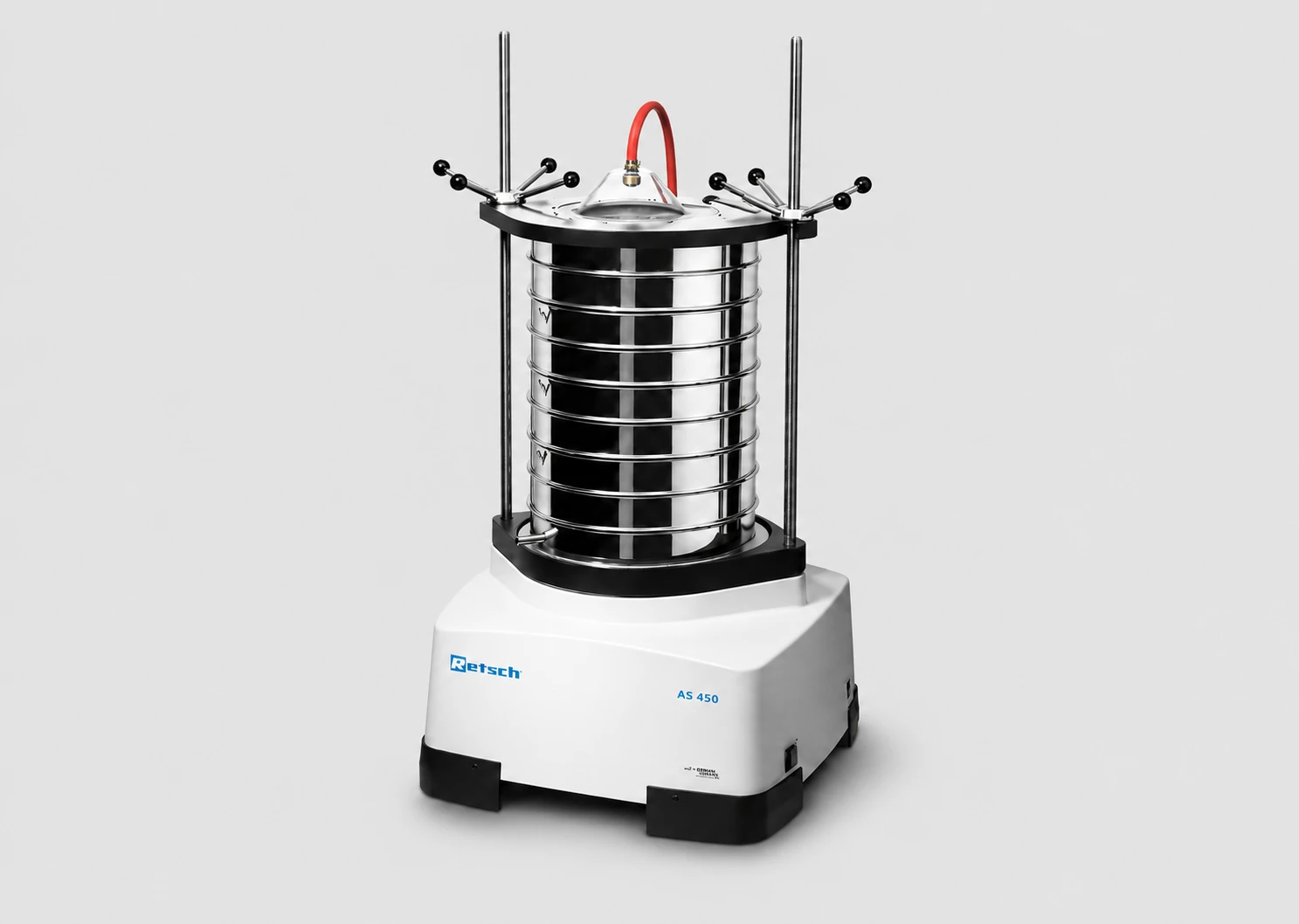
VIBRAToRy SIEVE SHAKER AS 450 CoNTRoL
Efficient electromagnetic drive with 3D movement
CET-Technology for controlled amplitude even with high loads (up to 25 kg)
Excellent separation efficiency even with short sieving times
Suitable for dry and wet sieving
Up to 14 / 11 fractions in one sieving operation, Ø 400 / 450 mm
Digital parameter setting, memory for up to 9 SOPs
RETSCH offers the widest range of sieving equipment worldwide covering a measuring range from 10 µm to 125 mm.
Particle analysis of large quantities of bulk goods is usually done by vibratory sieving. In most vibratory sieve shakers in the market the sieve stack is mounted on springs which oscillate vertically. However, to evenly distribute the material over the entire sieve surface, the so called 3d vibratory sieving as it is used in the AS 450 control is the most suitable method. This is characterized by a circular motion superimposing the vertical throwing motion so that the sample material is moved over the whole sieve.
Larger particles need high acceleration to rotate freely and then fall back statistically oriented. Therefore, a high amplitude is essential when the sieve stack carries heavy loads. Regardless of the load, the AS 450 control always generates amplitudes of up to 2.2 mm whereas other sieve shakers with electromagnetic drives only achieve 2 mm and, if the load increases, even substantially less. Sieve shakers with imbalance drives have long been considered as the most powerful systems in the market but have the great disadvantage of an uncontrolled drive. As a consequence, the energy input varies greatly depending on the load. With high loads the generated amplitude is so low that neither a complete separation nor reproducibility of the results are ensured. RETSCH has now combined the benefits of electromagnetic sieving – controlled amplitude with highest reproducibility – with the powerful drive based on the CET technology (Continuous Energy Transformation). The result is a sieve shaker that achieves the highest separation efficiency, regardless of the load, due to the continuous and controlled energy input, so that manual re-sieving becomes obsolete. (More information at
No bothersome manual re-sieving
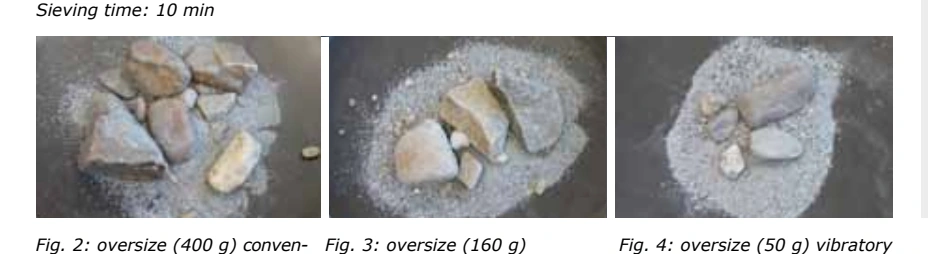
Pictures 2 to 4 show the oversize obtained by manual re-sieving after separating identical samples with vibratory sieve shakers of different manufacturers. The graphic clearly shows that the conventional sieve shaker with electromagnetic drive (based on pulse width modulation principle) provides the worst results (> 3.5% oversize). The sieve shaker with imbalance drives also shows a high percentage of oversize (approx. 1.5%) whereas the AS 450 control provides the best results with < 0.5%. This makes the AS 450 the only sieve shaker which meets the requirements of many standards (e.g. EN 933-1) for a sieve oversize of not more than 1% without manual re-sieving.
Comparison of sieve oversize
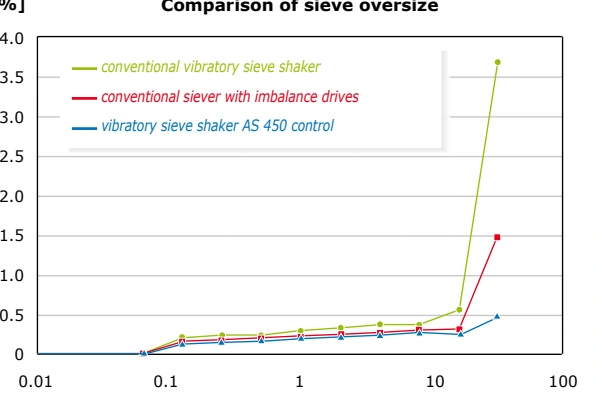
conventional vibratory sieve shaker conventional siever with imbalance drives vibratory sieve shaker AS 450 control
sieve size
[mm]
Parameters: Sieves: acc. to ISO 3310-1, Ø 450 mm, height 100 mm, mesh size 63 µm to 31.5 mm Material: 11 kg stones Amplitude: maximum of each sieve shaker respectively Sieving time: 10 min
Wet Sieving
In order to correctly separate agglomerated sample materials, some products need to be analyzed by wet sieving to ensure that the fine particles are washed out and evaluated according to their primary particle size. A special clamping device is available for this which is equipped with a spray nozzle that evenly distributes continually supplied water over the whole sieve surface. It is recommendable to place venting rings between the sieves with mesh sizes below 1 mm to compensate pressure.
oversize (160 g) siever with imbalance drives
oversize (50 g) vibratory sieve shaker AS 450 control
Field experience
have found out that the separation efficiency is particularly high when using the interval mode so that no manual re-sieving is required. Another advantage appreciated by Schultheis is the stability of the AS 450: “The oscillations of our former sieve shaker were not transferred to the sieve stack but to the floor which lead to problems with other tests, such as sedimentation analyses. The oscillation transfer of the AS 450 to the floor is so low that other tests are not affected in any way.”
Ingo Schultheis is not only happy about the high separation efficiency of the AS 450 control, he is also very content with the good quality of the materials used which fulfill RETSCH’s well-known high quality standards.
The Geological Office in Mainz, Germany supervises the exploitation of gravel, sand, split and rubble whereas the Mining Office evaluates filling materials. Both fields require sampling and analysis of these products in their own loose rock laboratory which is part of the central geotechnical laboratory. Since November 2009, this has been the workplace of the AS 450 control.
Ingo Schultheis, head of the geotechnical laboratory, expects high quality standards of the laboratory equipment he uses: “The accuracy of the sieving procedure, starting with sample division and ending with the particle size distribution curve, is a big issue for us. We are the highest supervisory body so we have to fulfill all relevant quality standards. That means we need measurement results which are exactly reproducible.”
The geotechnical lab analyzes many different samples. “The application field for the AS 450 control is very varied”, explains Schultheis. “It is used for round shaped sand of 0 - 2 mm as well as for broken rail track rubble from 0 – 70 mm, with and without interval mode.” Schultheis and his team
Sieving loose rock with the AS 450 control
Plan the configuration for your material.
A larger sieve arrangement does not eliminate the need for a representative test portion. Review loading, the sieve stack and recovery before setting a routine cycle. Compare retained fractions and repeatability on the actual material rather than assuming that more capacity means equivalent separation at any load.
| Consideration | Information to provide |
|---|---|
| Test quantity | Mass and bulk density |
| Sieve arrangement | Stack and required fractions |
| Method evaluation | Loading and endpoint consistency |
How should the application examples be used?
The results describe the materials and configurations discussed here. Confirm equipment options, contact materials and operating conditions for your own sample before adopting a method. A demonstrated endpoint does not guarantee the same outcome for a different material.
Discuss material testing with Glen Mills or request further information or a quote.