
Can fine grinding correct poor process sampling of slag?
No. Fine preparation addresses the selected portion. The initial sample must still represent the process material being assessed.
A variety of raw materials and slags need to be analyzed with regards to their mineralogical and chemical composition to optimize the steel production steps where these materials are involved. At each stage of the production, samples must be taken, processed and analyzed to ensure quality control without gaps. RETSCH offers a range of instruments suitable for sample preparation. The typical sample preparation process involves preliminary size reduction and fine size reduction before the sample can be submitted to further analyses. In case of subsequent XRF analysis, RETSCH also offers pellet presses as benchtop and floor models with different pressure forces.
Jaw Crusher BB 400 XL
Primary size reduction Usually, samples like ores or slags must be pre-ground prior to full homogenization by fine-grinding. Retsch offers a broad range of Jaw Crushers for this important step. The Jaw Crushers are used for the rapid, powerful crushing and pre-crushing of medium-hard, hard, brittle and tough materials. The variety of materials offered, their efficiency and safety make them ideal for sample preparation in laboratories and industrial plants. The throughput and final fineness depend on the crusher type, selected gap width and breaking properties of the sample material. The feed sizes range from 40 mm to 350 mm, depending on the model. Samples like iron ore slag may contain ductile metal parts which cannot be crushed. For this application the use of a Jaw Crusher with a front door is recommended (e. g. BB 250 XL, BB 400 XL) as these allow easy access to remove metal parts which may block the gap.
Pre-crushing of metal ore or slags in Jaw Crushers
| Sample | Sample amount | Feed size | Crusher Model | Parameters; Accessories | Final size | Time |
|---|---|---|---|---|---|---|
| Iron ore | 5 kg | 25 mm | BB 200 | Gap setting 2 mm; Jaws and wearing plates: manganese steel | < 5 mm | 2 min |
| Slag | 2.5 kg | 100 mm | BB 300 | Gap setting 5 mm; Jaws and wearing plates: manganese steel | < 15 mm | 40 sec |
| Slag | 440 g | 90 mm | BB 250 XL | Gap setting 5 mm; Jaws and wearing plates: manganese steel | < 10 mm | 3 min |
| Slag | 14.5 l | 45 mm | BB 50 | Gap setting 2 mm; Jaws and wearing plates: tungsten carbide | < 5 mm | 10 sec |
Vibratory Disc Mill RS 200
Homogenization of slag and raw materials
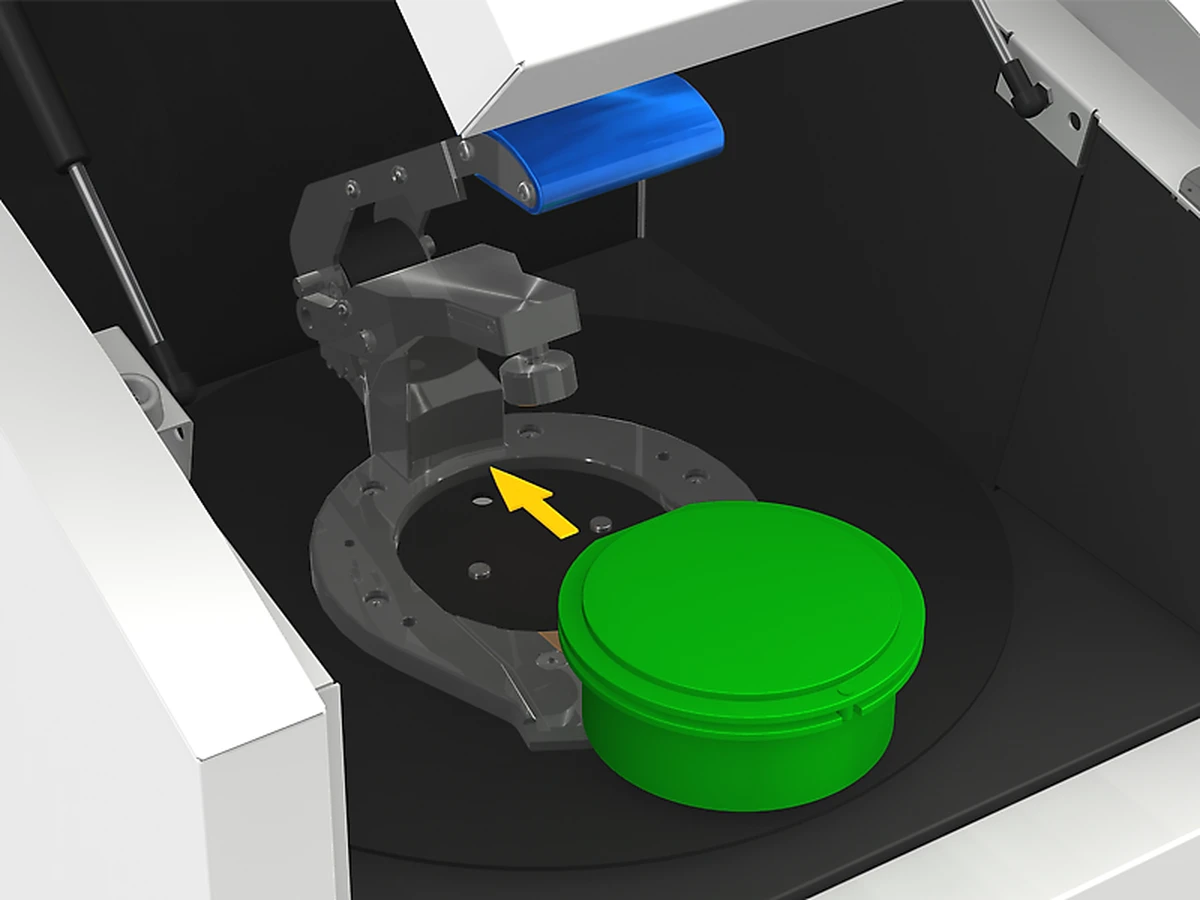
Pulverization RETSCH offers two models of Vibratory Disc Mills, RS 200 and RS 300 XL. The RS 200 is suitable for the extremely quick, loss-free and reproducible grinding of medium-hard, brittle and fibrous materials to analytical fineness. The instrument runs steadily and smoothly, even with heavy grinding sets, at maximum speed. With its robust design, the RS 200 has proven to be ideal for use in rough environments. Due to the high final fineness and speed the RS 200 is the perfect mill when it comes to preparing samples for spectral analysis. The model RS 300 X is used to process up to 4 samples simultaneously. Thanks to the robust universal drive shaft which sets the grinding jar into a 3-D motion, this mill accepts grinding set weights of up to 30 kg
Pulverization of metal ore or slag in Vibratory Disc Mills
Pellet pressing Solid, high-quality pellets are an important precondition for reliable and meaningful XRF analysis. With three different models (PP25, PP 35, PP40) RETSCH offers pellet presses with different pressure forces which produce strong pellets with a smooth surface. In case of metal ores /slags or metal powders, the use of a binding aid is very beneficial to produce stable pellets.
Production of stable pellets from metal ore or slag samples in Pellet Presses
| Sample | Sample amount | Feed size | Pellet Press | Parameters; Accessories | Remark |
|---|---|---|---|---|---|
| Blast furnace slag | 20 g | 50 µm | PP 35 | Pressing tool for 40 mm, aluminum cups 40 mm diameter; 15 t for 20 sec | Licowax was added in ratio 1:4 w/w (4 part sample + 1 part Licowax). |
| Metal powder | 15 g | 106 µm | PP 25 | Pressing tool for 32 mm diameter; 25 t for 1 min | Licowax: The pellet was stable but not homogeneous (separation Licowax and sample during grinding). Spectromelt: The sample was ground with two tablets Specromelt in a Mixer Mill MM 400. The pressing took place without addition of Licowax. The produced pellet was stable, no separation observed. |
Conclusion Quality control is an important aspect of steel production. Sample preparation is an essential part of it, because only a representative and reproducible processing of the sample material ensures reliable and meaningful analysis results. RETSCH offers a range of instruments for dividing, crushing, grinding and pressing all materials which are involved in the production process of steel. To ensure the right choice of instrument for the right sample material, Retsch offers free-of-charge sample testing in application laboratories all over the world.
Plan the configuration for your material.
A staged reduction sequence may be needed before fine preparation. Keep the sampling stage, crushing and analytical finishing clear in the record. Tool wear and the intended measurement should guide the grinding arrangement rather than treating all slag samples as mechanically identical.
| Consideration | Information to provide |
|---|---|
| Process sample | Stage and material identity |
| Reduction sequence | Coarse through analytical preparation |
| Assessment | Chemistry or mineralogical endpoint |
How should the application examples be used?
The results describe the materials and configurations discussed here. Confirm equipment options, contact materials and operating conditions for your own sample before adopting a method. A demonstrated endpoint does not guarantee the same outcome for a different material.
Discuss material testing with Glen Mills or request further information or a quote.
Explore the equipment discussed
- RETSCH RS 200 Vibratory Disc Mill
- RETSCH RS 300 Vibratory Disc Mill
- RETSCH BB 250 Jaw Crusher
- RETSCH BB 400 Jaw Crusher