
Does grinding mineral wool determine its classification by itself?
No. Preparation supports the specified chemical examination. Classification or safety conclusions require the applicable analytical criteria and qualified interpretation.
Mineral wools are artificial fibres typically made from spinning or drawing molten minerals and widely used as insulating and building material, in close proximity to humans. Here, three experts* on chemical analysis of mineral wool outline some of the most important considerations when evaluating these products for safe use in everyday applications.
We often come across
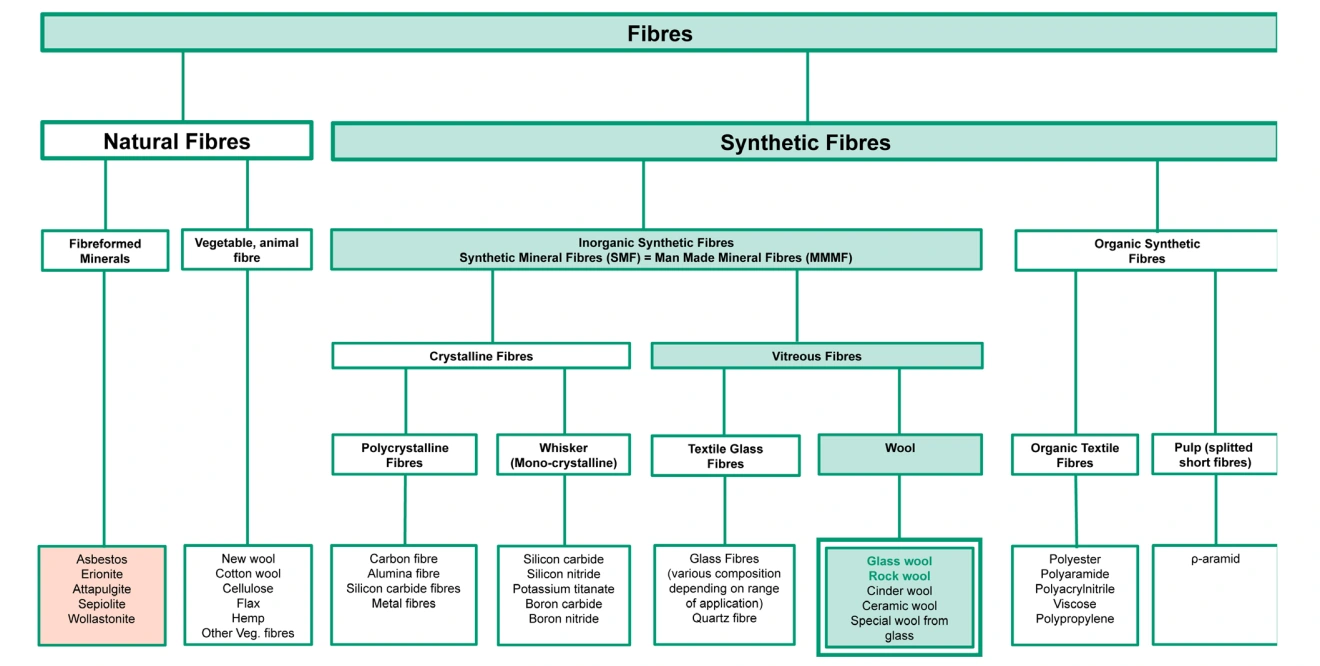
fibrous materials in everyday life. These fibres are either natural ones like cellulose, hemp and
asbestos, or artificial ones like polyester or viscose .
Alternatively, an intraperitoneal test needs to be passed to earn RAL certification. Mineral fibres that were produced in Germany until 1995 and sold until 2000 were widely used in buildings and have similarities to asbestos fibres, raising concerns over their safety.
The artificial kind comprise crystalline fibres
Mineral wool particles (length <250µm, diameter <3µm) are potentially harmful if they enter the lungs. The World Health Organization defines mineral wools as critical substances if the length exceeds 5µm, the diameter is smaller than 3µm and the ratio of length to diameter is more than three .
German safety standards for mineral wool In 1994, Germany’s Committee for Hazardous Substances defined a classification for artificial
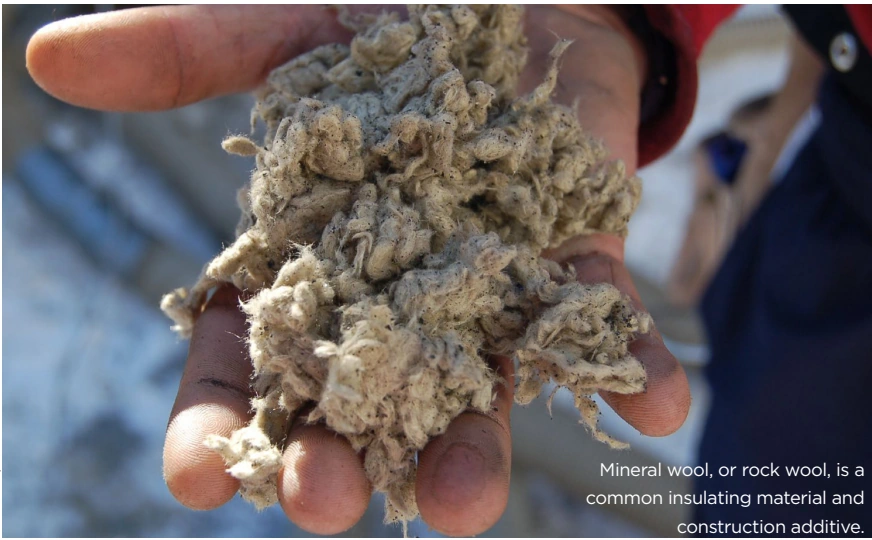
such as carbon fibre and silicon carbide, but also amorphous fibres like glass or rock wool. Glass-like fibres are commonly used as insulating wool or as an additive in construction materials to enhance stability, toughness and durability. As such, mineral wools are a significant end market for companies that mine and refine the elements that go into these products. Modern artificial mineral fibres are considered ecologically safe and perform well against environmental and health standards. According to European Union (EU) guideline 97/69/EG, these fibres are defined as “artificially produced glass-like (silicate) fibres with a content of alkaline or earth-alkaline mineral oxides (Na2O + K2O + CaO + MgO + BaO) above 18% (w/w)”. In 1998, the German Association of Mineral Wool (GGM) was founded under the umbrella of the German Institute for Quality Assurance (RAL), thus creating a voluntary internal and external mechanism for quality control. To obtain the RAL quality label, and thereby evidence that mineral fibres do not contain any harmful ingredients, producers need to prove, among other things, that their products pass an intratracheal test or score appropriately on an index of carcinogenicity and pass an intratracheal test, short-term inhalation test or long-term inhalation test.
r k c i l F a v
mineral fibres, which not only guides on length and diameter but also the persistence of the fibres in the human body. The faster the fibres dissolve in the lungs, the lower the risk of them causing serious health problems. The bio-solubility of fibres describes the capacity of any organism to damage and repel the fibre from the body. This is done with the help of macrophages and lung surfactant (pH 7.4) which chemically attack the fibres before macrophages remove them. Since 1994, a formula has been used to determine the index of carcinogenicity (IC) to evaluate the persistence of the fibres in the body . Some producers of mineral wool felt that the IC did not sufficiently describe the biosolubility of mineral fibre and, in 1995, it was proved that the index gave incorrect information on the bio-solubility of modern
Classification of fibres
rock wool. In contrast to other types of mineral fibre, the aluminium oxide in modern rock wool served to enhance their bio-solubility, rather than reduce it. Consequently, this IC was not included in the 1997 EU guideline defining artificial mineral wool. Around 1997, a collaboration between Germany’s Fraunhofer Institute for Toxicology and Aerosol Research, the Fraunhofer Institute for Silicate Reaearch and various German mineral wool producers and associations helped to develop modern artificial mineral fibres with more positive environmental and health aspects. The bio-solubility of modern mineral fibres is determined by the length-to-diameter ratio of
the fibres, as well as by their persistence in the human body. It is therefore vital that the sanitary evaluation of mineral fibres obtains correct and reliable chemical analyses, both during production processes and during recycling or dismantling of buildings. Fibres are evaluated in accordance with the criteria of the German Ordinance on Hazardous Substances set by the German Association of Mineral Wool (Annex II, No. 5). There are four institutes approved by the German Association of Mineral Wool which analyse artificial mineral fibres, including the IGR Institute for Glass and Raw Material Technology GmbH, based in Gottingen (see box).
The IGR has developed a comprehensive auditing process, which is based on duplicate determination of all parameters . For example, mineral wool element oxides are analysed with two separate ICP-OES instruments against an IGRproduced and matrix-adjusted internal standard. Elements with higher concentrations, like sodium, potassium, calcium, and magnesium are analysed with radial plasma observation, whereas elements with lower concentrations, like cadmium, lead, and chromium, are analysed with the more sensitive axial plasma observation. In addition to the fibre sample designated for testing, IGR always analyses another mineral fiber sample with the same matrix as a reference.
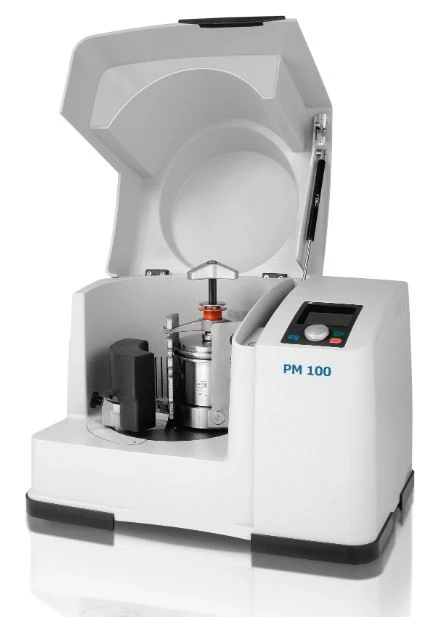
Grinding parameters for artificial mineral fibres in the Planetary Ball Mill PM 100 and Mixer Mill MM 400
Determining the carcinogenicity of fibres
IC = ∑ (Na2O, K2O, B2O3, CaO, MgO, BaO) - 2 x Al2O3
KEY:
IC ≥40
Not carcinogenic (no category)
IC >30 to <40 Potentially carcinogenic (C3)
IC ≤30
Carcinogenic (C2)
Equipment for mineral wool sampling Prior to reliable analysis, mineral wool fibres must be homogenised in a laboratory mill. This is an important step during which there is a risk of preparation mistakes. For example, only a few milligrams of sample are required for elemental analysis by ICP- OES, but this small amount needs to represent the complete initial sample. Depending on the part of the original sample
Pott, F./Freidrichs, K H: Tumoren der Ratte nach i.p.-Injektion faserförmiger Stäube, in Naturwissenschaften 59, S. 318, 1972. Bayerisches Landesamt fur Umwelt: UmweltWissen, Künstliche Mineralfasern, 2008. Bundesanstalt für Arbeitsschutz und Arbeitsmedizin: 905-anorganische-fasern, Januar 2002 GGM Gütegemeinschaft Mineralwolle e.V.: Aktualisierung des Merkblatts, „Bewertung von Mineralwolle-Dämmstoffen im Zusammenhang
mit Abbruch-, Sanierungs-, lnstandhaltungs- und Instandsetzungsarbeiten“, Mai 2016 Laborpraxis: Kleine Partikel – großer Effekt: Planeten-Kugelmuhlen erlauben die Herstellung von Nanopartikeln; April 2011
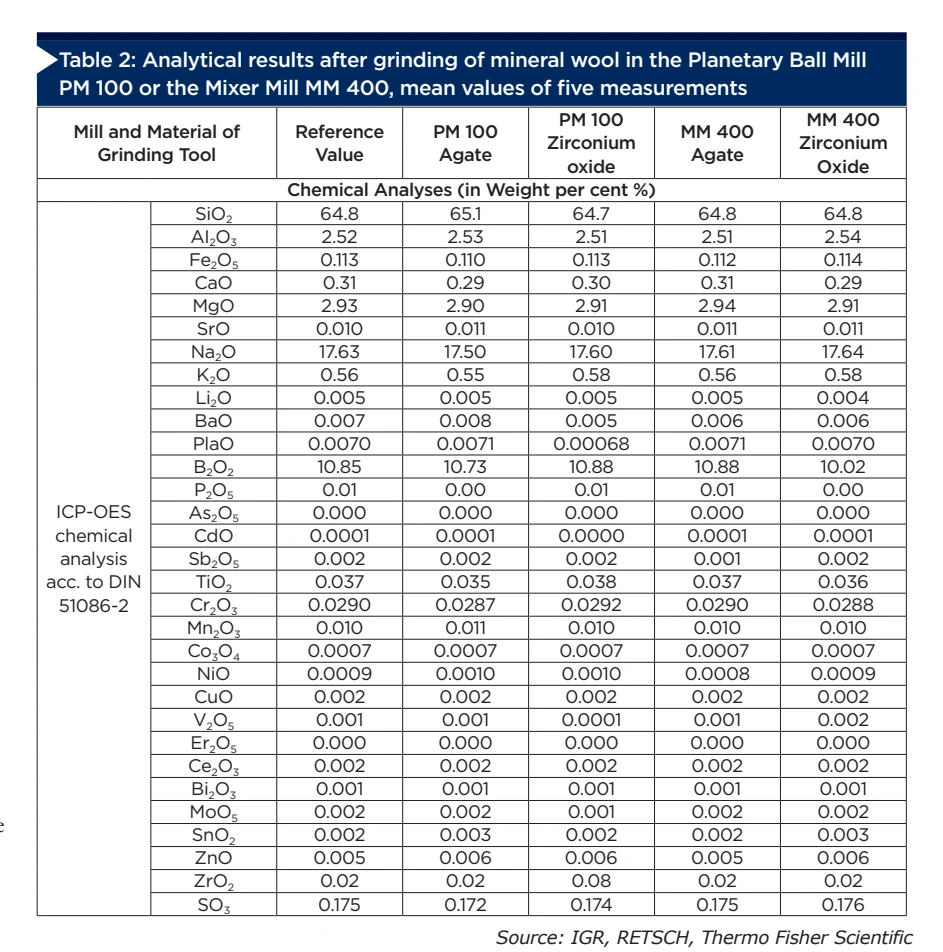
from which the sub-sample is taken, its composition may vary. Reproducible sample homogenisation prior to analysis is a premise for reliable results. Accuracy of the analysis depends on the choice of mill and grinding tool material (agate or zirconium oxide are examples of materials commonly used) but also on parameters like speed or frequency. Agate tools, for example, increase the concentration of silicon dioxide (SiO2) due to abrasion. The German Association of Mineral Wool stipulates sample preparation of fibres with agate tools. The quantity of the sample is also relevant – too little sample material in the jar leads to increased wear, resulting in more abrasion and dilution of the sample. This may falsify the values obtained by subsequent analysis. At a time when consumer groups and governments are increasingly conscious of toxicity risks of everyday materials and with an ever-growing precedent for legal action against manufacturers of products found to be harmful, accurate analysis of mineral wools is becoming increasingly crucial. Leading engineering and biotechnology groups, academic institutions and industry bodies are among those leading the charge to ensure than manufacturers and consumers have confidence in the products they sell and buy. As well as being vital for safety, the role performed by these bodies is important to protect the producers of minerals that go into making the wools used in everyday applications worldwide.
References Bundesinstitut fur Bau- Stadt und Raumordnung: Kunstliche Mineralfaserdammstoffe BBSR-Berichte KOMPAKT, 1/2011. Mai, Anna: Unter Dach und Fach, Test Dachdammstoffe, in Oko-Test 10/2009, S. 140–148. Amtsblatt der Europaischen Gemeinschaften: Richtlinie 97/69/EB der KommiL 343/10, 13.12.97. Gutegemeinschaft Mineralwolle e.V.:Gesundheitliche Bewertung von Mineralwollen an Hand der Bioloslichkeit, 2015 Gutegemeinschaft Mineralwolle e.V.: Die Güte- und Prüfbestimmungen, April 2013
Analytical results after grinding of mineral wool in the Planetary Ball Mill PM 100 or the Mixer Mill MM 400, mean values of five measurements
| Analyte | Reference | PM 100 / agate | PM 100 / zirconium oxide | MM 400 / agate | MM 400 / zirconium oxide |
|---|---|---|---|---|---|
| SiO₂ | 64.8 | 65.1 | 64.7 | 64.8 | 64.8 |
| Al₂O₃ | 2.52 | 2.53 | 2.51 | 2.51 | 2.54 |
| Fe₂O₅ | 0.113 | 0.110 | 0.113 | 0.112 | 0.114 |
| CaO | 0.31 | 0.29 | 0.30 | 0.31 | 0.29 |
| MgO | 2.93 | 2.90 | 2.91 | 2.94 | 2.91 |
| SrO | 0.010 | 0.011 | 0.010 | 0.011 | 0.011 |
| Na₂O | 17.63 | 17.50 | 17.60 | 17.61 | 17.64 |
| K₂O | 0.56 | 0.55 | 0.58 | 0.56 | 0.58 |
| Li₂O | 0.005 | 0.005 | 0.005 | 0.005 | 0.004 |
| BaO | 0.007 | 0.008 | 0.005 | 0.006 | 0.006 |
| PlaO | 0.0070 | 0.0071 | 0.00068 | 0.0071 | 0.0070 |
| B₂O₂ | 10.85 | 10.73 | 10.88 | 10.88 | 10.02 |
| P₂O₅ | 0.01 | 0.00 | 0.01 | 0.01 | 0.00 |
| As₂O₅ | 0.000 | 0.000 | 0.000 | 0.000 | 0.000 |
| CdO | 0.0001 | 0.0001 | 0.0000 | 0.0001 | 0.0001 |
| Sb₂O₅ | 0.002 | 0.002 | 0.002 | 0.001 | 0.002 |
| TiO₂ | 0.037 | 0.035 | 0.038 | 0.037 | 0.036 |
| Cr₂O₃ | 0.0290 | 0.0287 | 0.0292 | 0.0290 | 0.0288 |
| Mn₂O₃ | 0.010 | 0.011 | 0.010 | 0.010 | 0.010 |
| Co₃O₄ | 0.0007 | 0.0007 | 0.0007 | 0.0007 | 0.0007 |
| NiO | 0.0009 | 0.0010 | 0.0010 | 0.0008 | 0.0009 |
| CuO | 0.002 | 0.002 | 0.002 | 0.002 | 0.002 |
| V₂O₅ | 0.001 | 0.001 | 0.0001 | 0.001 | 0.002 |
| Er₂O₅ | 0.000 | 0.000 | 0.000 | 0.000 | 0.000 |
| Ce₂O₃ | 0.002 | 0.002 | 0.002 | 0.002 | 0.002 |
| Bi₂O₃ | 0.001 | 0.001 | 0.001 | 0.001 | 0.001 |
| MoO₅ | 0.002 | 0.002 | 0.001 | 0.002 | 0.002 |
| SnO₂ | 0.002 | 0.003 | 0.002 | 0.002 | 0.003 |
| ZnO | 0.005 | 0.006 | 0.006 | 0.005 | 0.006 |
| ZrO₂ | 0.02 | 0.02 | 0.08 | 0.02 | 0.02 |
| SO₃ | 0.175 | 0.172 | 0.174 | 0.175 | 0.176 |
Analysis of mineral fibres at IGR
Following the instructions of the German Association of Mineral Wool, the sample must be ground in agate and information on the following parameters must be provided:
- Loss of ignition according to DIN 51081:2002-12, verification of oxidic raw materials
- Hydrofluoric acid - perchloric acid - hydrolysis according to DIN 52340 part 3 for all elements except boron and silicone, subsequent analysis of element oxides Al2O3, CaO, MgO, Na2O, Fe2O3, K2O, TiO2, SO3, MnO, P2O5, BaO, Cr2O3, PbO, SrO, ZnO, ZrO2 by ICP- OES according to DIN 51086 part 2
- Hydrolysis for analysing the element boron with basic fusion – according to EN ISO 21078 part 1 - DIN 52340 part 3, by ICP-OES according to DIN 51086 part 2
- Quantitative gravimetric SiO2 determination according to DIN 52340 • Information on “uncertainty of measurement”, “precision” and “correctness” in the audit report
Plan the configuration for your material.
When trace elements matter, compare the tool material with the analytes being measured. Preparation blanks and a suitable reference material help separate sample composition from introduced contamination. Fine appearance alone does not establish that the prepared portion represents the original fibers.
| Consideration | Information to provide |
|---|---|
| Analytical scope | Elements or composition being measured |
| Grinding tools | Material and contamination risks |
| Quality controls | Reference material and preparation blanks |
How should the application examples be used?
The results describe the materials and configurations discussed here. Confirm equipment options, contact materials and operating conditions for your own sample before adopting a method. A demonstrated endpoint does not guarantee the same outcome for a different material.
Discuss material testing with Glen Mills or request further information or a quote.