

Does reaching a smaller particle size prove a better anode?
No. Particle preparation must be followed by the relevant material and electrochemical evaluation. Fineness alone is not a battery-performance result.
Silicon is gaining increasing importance as an anode material for Li ion batteries. Its exceptionally high specific capacity of about 3,600 mAh/g allows it to store roughly ten times more lithium ions than conventional graphite. This potential makes silicon a key material for anodes or as an additive in carbon–silicon composite anodes. A crucial factor for the performance of Li ion batteries is the particle size of the silicon: it significantly influences the electrochemical behavior, cycle stability, and service life of the anode. For battery applications, silicon particles are therefore specifically adjusted to sizes ranging from a few micrometers down to the sub micrometer and nanometer scale.
Comparison of Grinding Mechanisms in Modern Ball Mills
Modern ball mills allow small amounts of material to be ground precisely to the desired fineness, enabling the production of tailored particle sizes. The different mill types vary primarily in the motion of the grinding jar, which strongly shapes the grinding outcome: In a planetary ball mill , the grinding jar rotates along a circular path (“sun wheel”), generating predominantly frictional forces between the balls and the material. In contrast, in a mixer mill , the jar moves in an oscillating motion within a horizontal plane. This pattern results in particularly high mechanical stress on the sample due to frequent impact and collision events, enabling fast and efficient size reduction. The high energy ball mill Emax combines both mechanisms and, through its very high rotational speed and targeted control of impact and friction effects, achieves an exceptionally high energy input.
Each mill offers its own advantages in terms of performance and handling .
PM 300
MM 500 control
Retsch visualises the features and strengths of each ball bill model in a diagram to help finding the right model for a specific application. In the example shown it is easy to see that the Planetary Ball Mill PM 300 offers advantages in terms of power, final fineness and maximum jar volume compared to the Mixer Mill MM 500 control. The latter in terms offers easier handling, versatility and the ability to control the temperature during the process.
Optimal Combination of Jar, Balls, and Parameters for Efficient Size Reduction
In addition to the type of mill, the size and material of the grinding jar, as well as the size, number, and material of the grinding balls, play an important role in the grinding outcome. Different jar materials, such as zirconium oxide or stainless steel, offer advantages in terms of abrasion resistance and chemical stability. Smaller balls promote fine grinding, whereas larger balls are more effective for breaking up coarse particles. The optimal combination of these factors, along with the choice of grinding parameters - particularly rotational speed, processing time, and filling ratio - determines the achievable fineness and particle size distribution. Depending on the material and application, it may also be necessary to include grinding breaks to avoid excessive heating and ensure process safety. In the following example, silicon is comminuted using three different high performance mills, all of which are characterized by high rotational speeds or frequencies and a correspondingly high energy input.
Particle Size Adjustment Using the MM 500 nano Mixer Mill
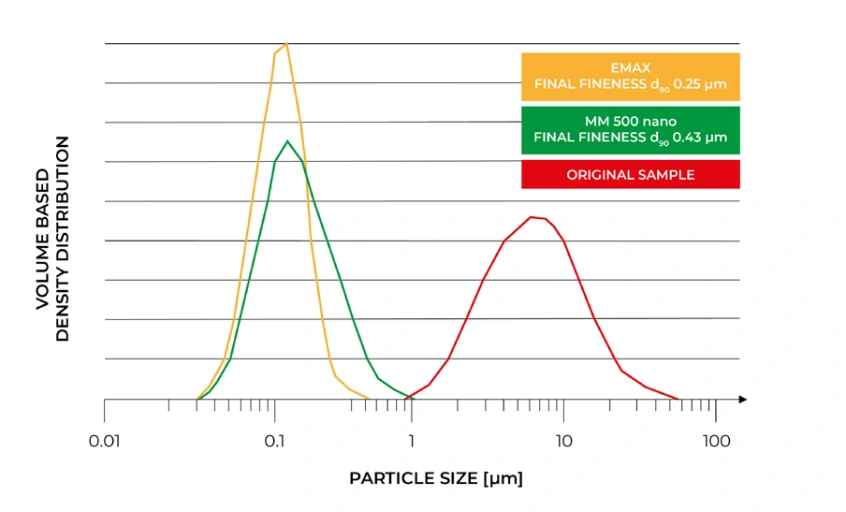
The nano mixer mill MM 500 is a compact and versatile benchtop device designed specifically for rapid dry, wet, and cryogenic grinding of up to 2 × 45 ml of sample material. With a maximum frequency of 35 Hz, the mill provides sufficient energy to achieve particle sizes down to the nanometer range. Thanks to its robust high performance drive, it is also suitable for long term grinding processes of up to 99 hours, making it highly appropriate for research and development applications. For the grinding of silicon, a 125 ml zirconium oxide grinding jar is filled with 275 g of grinding balls with a diameter of 0.5 mm. For wet grinding, 20 g of silicon powder and approximately 30 ml of isopropanol are added and mixed, resulting in an oil like viscosity. Grinding is carried out at the maximum frequency of 35 Hz, with the mill being stopped after 30 minutes to add an additional 5 ml of liquid in order to maintain viscosity. After a total processing time of 60 minutes, the particle size was reduced from d90 = 30 µm to d90 = 0.5 µm. No further reduction could be observed even with extended grinding time.
Mixer Mill MM 500 nano
The resulting particle size distribution after 60 minutes is shown in Figure 5.
Particle Size Adjustment Using the High Energy Ball Mill Emax
The high energie ball mill Emax from Retsch is an innovative mill designed for highly efficient size reduction at rotational speeds of up to 2,000 rpm. It combines friction and impact, enabling the production of very fine particles in a short amount of time. The integrated water cooling system allows for long term milling without cooling interruptions, and the temperature monitoring with automatic start/stop ensures safe operation within the defined temperature limits.
For the milling of silicon, a 125 ml zirconium oxide grinding jar was filled - analogous to the MM 500 nano setup - with 275 g of grinding balls with a diameter of 0.5 mm. Using the same setup as before, 20 g of silicon powder and approximately 30 ml of isopropanol were added, and the process was carried out for 60 minutes at the maximum speed of 2,000 rpm. The resulting particle size distribution is shown in Figure 5 and exhibits a narrower particle size distribution compared to the MM 500 nano.
High Energy Ball Mill Emax
Particle Size Adjustment Using the Planetary Ball Mill
Planetary ball mills such as the PM 300 generate high centrifugal forces and intense friction effects between the balls and the material. They are particularly suitable for larger sample quantities, as grinding jars of up to 500 ml are available. Compared with the mixer mill and the water cooled Emax, the temperature inside the grinding jar tends to rise more strongly in a planetary ball mill, especially when large jar volumes are used. The increase in temperature and pressure requires regular cooling breaks, which extends the total process time. A safety closure device, as well as cooling the jar in a water bath after milling, ensures process safety. For temperature sensitive materials, ball mills with active temperature control, such as the Emax or the MM 500 control, are therefore recommended.
: Planetary Ball Mill PM 300
Conclusion
All three types of ball mills presented, the nano mixer mill MM 500, the high energy ball mill Emax, and the planetary ball mill PM 300, can be used to accurately adjust silicon particles to the sizes required for batteries. High-performance mills such as Emax and MM 500 nano are particularly suitable for the production of particularly fine and uniform particles, whereas Emax offers additional process reliability thanks to its integrated temperature control. The planetary ball mill can demonstrate its strengths when processing larger quantities or more robust materials. The key to optimal results is the careful selection of the mill, the adjustment of grinding parameters, and careful monitoring of the process.
Plan the configuration for your material.
Planetary and mixer mills produce different jar motions and energy-transfer conditions. Compare the prepared silicon by an appropriate measurement, not operating time alone. Track contamination and the complete distribution, particularly where an apparently similar average size could hide different coarse or fine fractions.
| Consideration | Information to provide |
|---|---|
| Starting silicon | Form and initial size |
| Target distribution | Measurement method and limits |
| Material integrity | Contamination and test requirements |
How should the application examples be used?
The results describe the materials and configurations discussed here. Confirm equipment options, contact materials and operating conditions for your own sample before adopting a method. A demonstrated endpoint does not guarantee the same outcome for a different material.
Discuss material testing with Glen Mills or request further information or a quote.
Explore the equipment discussed
- RETSCH Emax High Energy Ball Mill
- RETSCH PM 300 Planetary Ball Mill
- RETSCH MM 500 nano Mixer Mill
- RETSCH MM 500 control Mixer Mill