
Basic materials · Quality control
Prepare ores for elemental analysis.
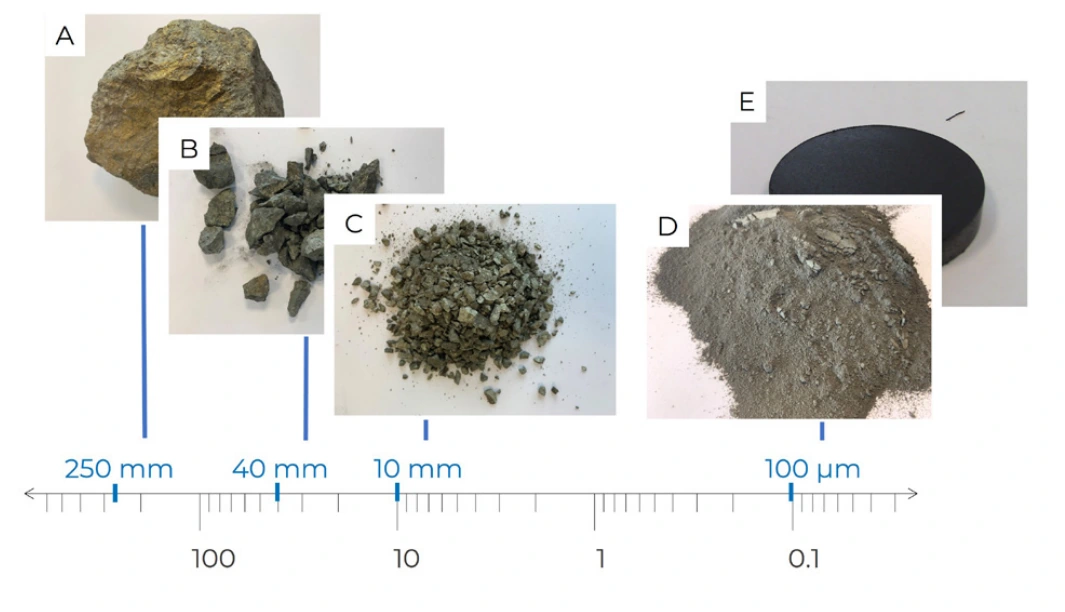
Only a few grams may be needed to analyze valuable constituents such as lithium, manganese or cobalt. The challenge is preparing those grams so that they represent the original mineral sample.
A preparation route can combine pre-crushing, fine grinding, sample division and pellet pressing. Each stage has a different job: making large pieces manageable, homogenizing material, obtaining a representative smaller portion and presenting it for analysis.
- Pre-crushReduce coarse ore pieces.
- Fine-grindPrepare a homogeneous powder.
- DivideObtain the analytical portion.
- PressPrepare an XRF pellet where required.
Components · Research
Develop solid-state battery components.
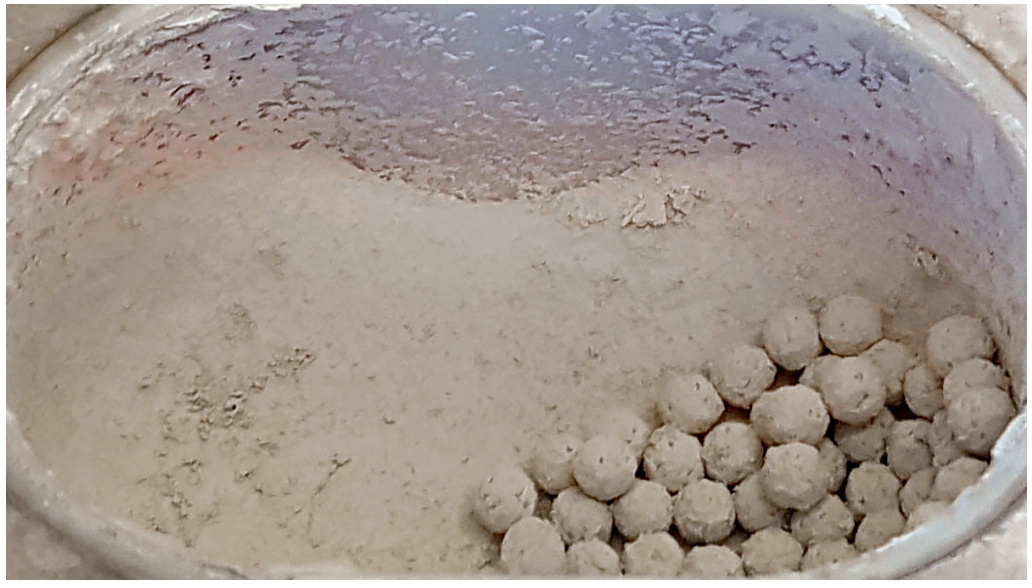
The physical arrangement of active materials is important in all-solid-state battery development. Laboratory ball mills can be used to pulverize, mix and coat electrode materials, or to investigate mechanochemical reactions.
Temperature-controlled preparation helps researchers investigate sensitive materials under a defined thermal arrangement. The RETSCH MM 500 control offers a temperature-control concept described over a range of −100 °C to +100 °C; the thermal supply, vessels and supported configuration govern the available operating conditions.
Define the target particle distribution, contact materials and required atmosphere before discussing a configuration. A temperature setting alone does not describe the entire material-preparation method.
Electrode materials · Research & quality control
Pulverize and mix electrode powders and slurries.
Planetary ball mills and mixer mills are used in laboratory-scale grinding, coating and mixing of battery active materials. High-energy arrangements such as the RETSCH MM 500 nano and Emax can be used to investigate very fine preparation, including nanometer-scale endpoints for suitable materials and conditions.
The result depends on the sample and complete grinding setup. Choose the jar, media, loading and any liquid phase around the required prepared material, then verify the resulting distribution rather than assuming a universal fineness.
| Series | What it represents |
|---|---|
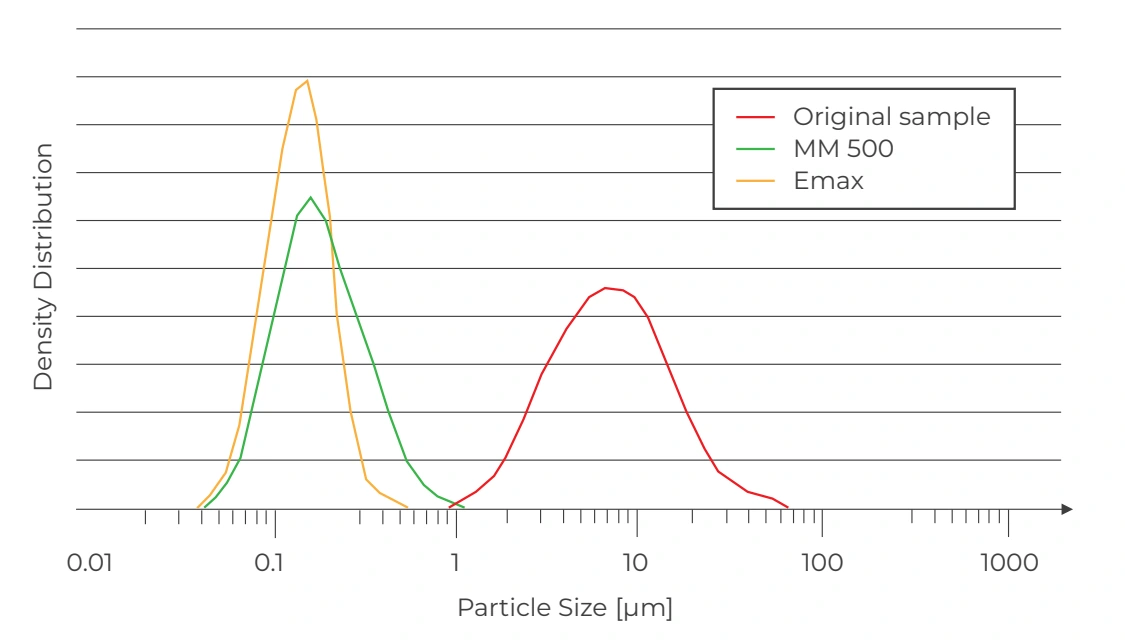
| Original sample | Silicon before the illustrated wet-grinding preparations. |
| MM 500 | Prepared silicon from MM 500 nano wet grinding with zirconium oxide tools. |
| Emax | The comparison preparation shown by the yellow/orange curve. |
The example compares distributions, not universal mill performance. The graph does not provide a numeric vertical-axis scale or raw data; no additional values have been inferred.
Explore RETSCH MM 500 nanoExplore Microtrac SYNC measurement
Particle analysis · Research
Characterize battery-material size fractions.
Sieving characterizes the particle fractions of suitable electrode materials. RETSCH's sieve portfolio includes different motion patterns and sieve diameters, with aperture options across the portfolio ranging from 10 µm to 125 mm. That span does not describe the working range of every individual instrument or method.
For fine powders such as graphite that tend to agglomerate, the RETSCH AS 200 jet air jet sieving machine provides an approach to investigate. Representative division with the PT 100 can be performed before the sizing procedure.
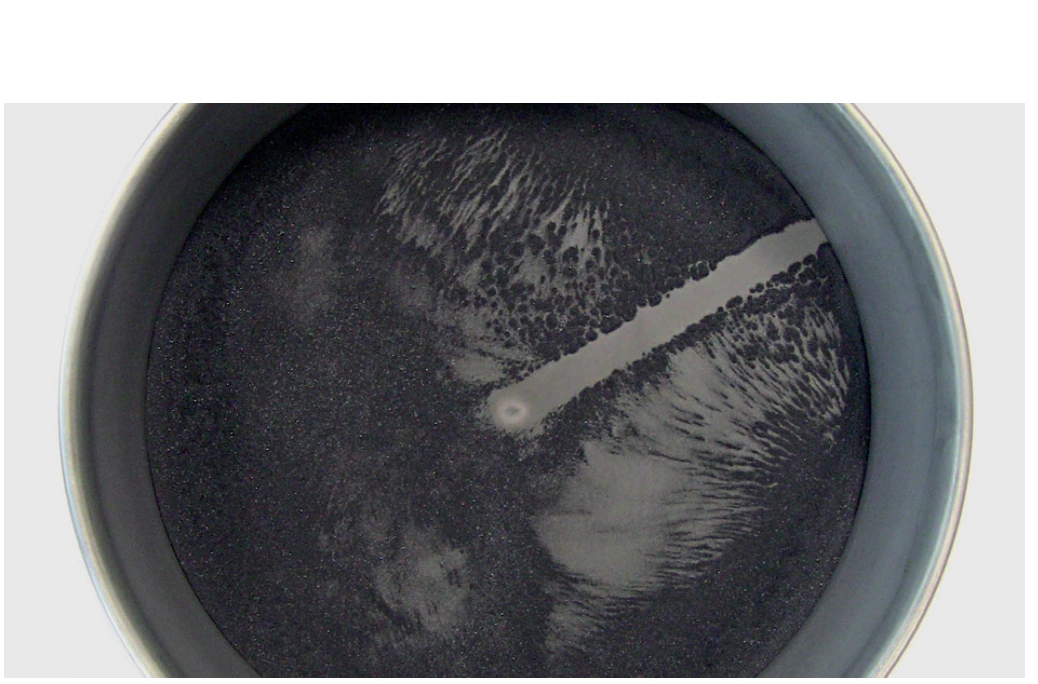
Specify the powder condition, required fractions and dispersion objective. Sieve aperture is a tool dimension; the test procedure and sample behavior determine the result.
Recycling · Research & quality control
Separate battery-material fractions.
Cutting and sieving can support laboratory research into battery recycling routes. Size reduction makes suitable material available for subsequent separation, while sieving is one way to distinguish black mass from polymeric and metallic fractions.
RETSCH SM 300 cutting-mill and sieve arrangements can be discussed around the material state, working quantity and separation objective. Research arrangements may include sieves up to 450 mm in diameter, depending on the chosen equipment.
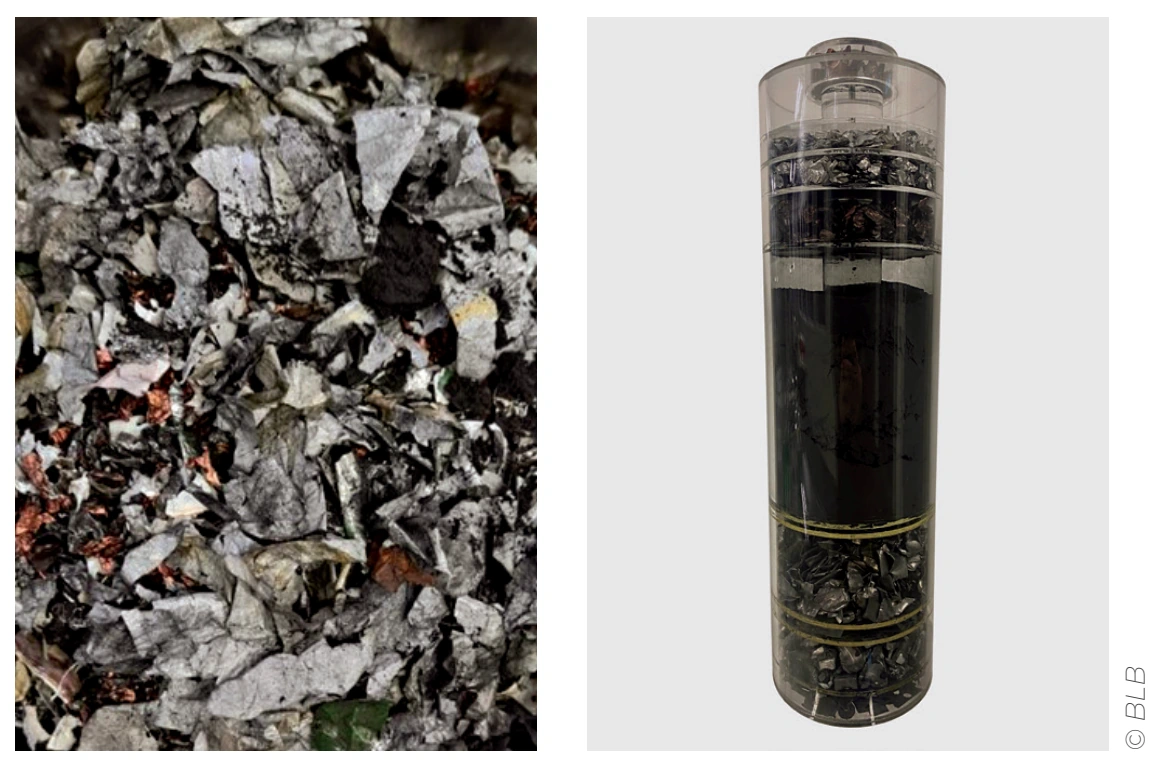
Battery material must first be assessed and made suitable for the approved laboratory handling process. These prepared research examples are not instructions for milling energized cells.
Recycling · Research & quality control
Homogenize recycling fractions for analysis.
After a recycling process separates material fractions, analysis helps investigate their purity, composition and value. For example, the composition of black mass includes metals of interest such as lithium or cobalt, so the analytical portion needs to represent the fraction being assessed.
Black mass can be homogenized with a suitable ball-mill arrangement. Grinding tools should be chosen to avoid introducing elements that would interfere with the intended analysis. Polymeric fractions and metallic foils can require pre-cutting and, depending on their behavior, cold preparation.
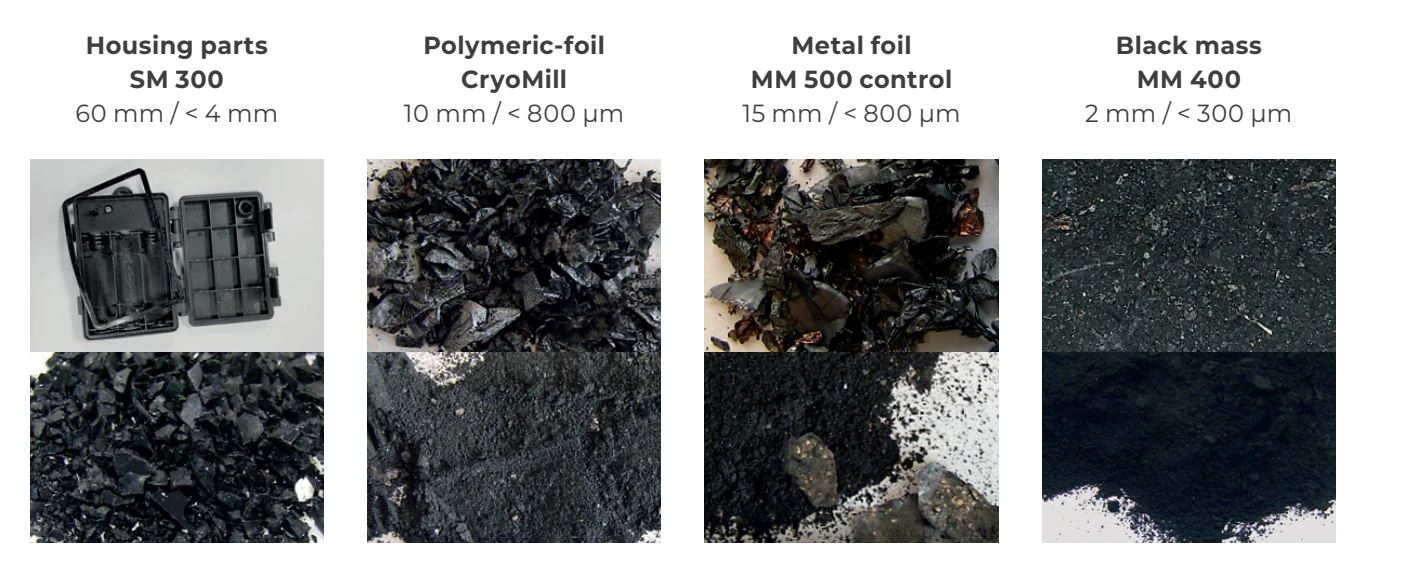
| Fraction | Mill shown | Starting size | Prepared size |
|---|---|---|---|
| Housing parts | RETSCH SM 300 | 60 mm | < 4 mm |
| Polymeric foil | RETSCH CryoMill | 10 mm | < 800 µm |
| Metal foil | RETSCH MM 500 control | 15 mm | < 800 µm |
| Black mass | RETSCH MM 400 | 2 mm | < 300 µm |
Match the preparation to the battery-material question.
Tell Glen Mills whether the task concerns raw-material analysis, component development, particle sizing or a recycling fraction. Include the material, starting size, working quantity, target result and any atmosphere, temperature or contamination constraints.
Can one preparation route cover every battery material?
No. Ore, electrode slurry, graphite and separated recycling fractions have different physical behavior and analytical requirements. Define the task before selecting the equipment and tools.
How should the illustrated results be used?
Use them as application examples to guide a configuration discussion. A representative material evaluation is needed before adopting a method or treating a demonstrated endpoint as an expectation for another sample.
Discuss material testing with Glen Mills or request further information or a quote.