
Does fine grinding correct a biased sample division?
No. Grinding can homogenize the selected portion but cannot restore components that were excluded when the portion was chosen.
The following situation is typical for many production plants: After a routine quality check, the production process is stopped or an already produced batch is suspended, because the analysis results did not meet the relevant critical values. But does the analyzed product really deviate from the specifications? The quality control managers are convinced of this because modern analysis instruments provide results with very low tolerances. The sample in question is tested several times and the result is confirmed. The question is why the product does not match the specifications although the production parameters have not been changed in any way.
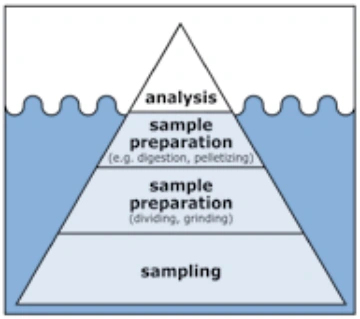
The possibility that the tested product is indeed deficient cannot be excluded. However, it is often not the product itself which causes irregular analysis results but a lack of understanding of the steps which come before the analysis. Just like an iceberg which is for the greatest part under water, only a small part of the sum of errors is perceived whereas the major part of potential errors is not taken into account . One reason for this may be that the high accuracy of modern analytical equipment is regarded as the maximum absolute error of the sample preparation process.
Another reason may be the fact that sampling and sample preparation are done in a traditional way which has become a routine over the years and is no longer regarded as having a critical influence on the
subsequent analyses. The comparison demonstrates that the influence of an error in one of the described steps on the final analysis result can be much bigger than the error which finally occurs during analysis. Moreover, the errors of each step add up, i.e. the error increases during the process (error propagation). The question is now how these errors occur and what can be done to minimize them. In this discussion, these questions are discussed for the sampling and sample preparation of solids.
Sample handling - Sampling
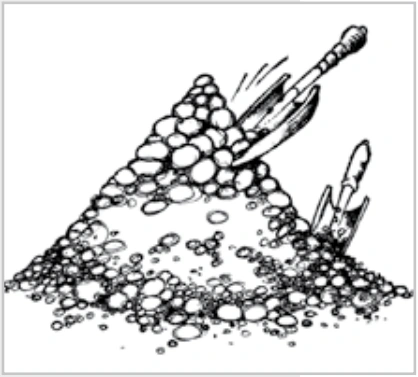
Generally speaking, the more heterogeneous a sample is, the more important becomes the correct sampling and sample preparation method. For example: A heap of sand consists of a mixture of bigger stones and smaller sand grains. The stones are found in the upper part, the grains are at the bottom . If a sample is taken only from the upper or lower part of the heap, it consists mostly of stones or grains of sand respectively and is in no way representative of the complete heap. The particle size has an influence on the sample amount: If 100 g of sample are taken, obviously considerably more sand grains than stones are needed to obtain the required mass. If the heap of sand was stored outside, then the material on the surface of the heap contains more moisture than the inside part. This means that the property “moisture” is distributed heterogeneously in the initial material and the required sample amount depends on the distribution range of this sample property. This simple example demonstrates that sampling and the complete sample handling are strongly influenced by the properties of the initial material. As the sample must “represent” all properties of the initial material with statistical security, samples in the example must be taken from different points in the heap to ensure that the distribution of large and small as well as dry and moist sand grains is fully covered.
If a representative sample has been taken, it will have the same properties as the initial material. The sample may show heterogeneously distributed properties as well as segregation effects. During the transport of bulk goods, the larger particles always settle in the upper part of the bulk and the smaller particles at the bottom. That is uncritical if the entire sample is used for analysis. In most cases, however, only a small part of the sample is required so that the volume needs to be reduced. There are two ways to obtain a representative sub-sample: sample division and grinding. Sample division is used to reduce the sample volume. Grinding improves the mixing properties and homogenizes the sample. A representative sub-sample can also be obtained by combining the two methods, taking into account the product properties and subsequent analysis method. Care must be taken that the properties of the sample are not altered by the preparation process. This can also be explained with our example: if the particle size distribution of the sand sample is to be determined, the sample must not be ground. If the moisture content is analyzed, the sample must not be heated to prevent the contained water from evaporating. In the following the sample division methods are discussed in detail.
Sample division
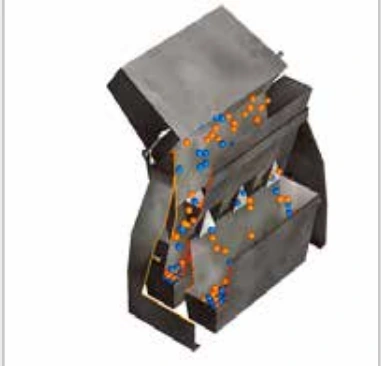
It is very likely that the sample properties are distributed heterogeneously so that a simple, random and representative extraction of a sub-sample is almost impossible. Standardized methods such as coning and quartering, or the use of sample splitters or rotating sample dividers may be useful. For coning and quartering, the sample is formed into a conical heap and then divided into 4 equal parts. Now two opposite quarters are mixed and further quartered by the same method until an appropriate sample volume remains for analysis. The sample splitter (fig. 3, left) is equipped with an even number of equally sized passages which have alternating outlets to the right and left side. The sample is poured from the top into the sample splitter. As all the passages have the same size and each side has the same number of outlets, the sample is split into two equal halves. By further dividing one half, the sub-sample can be further reduced.
In a rotating sample divider such as RETSCH's PT 100, the sample is fed into the hopper and automatically transported via a feed chute to the openings of an evenly rotating dividing head (fig. 3, middle). The sample falls from the end of the chute into the rotating dividing head which divides the sample flow into 6, 8 or 10 sub-samples, depending on the number of outlets. After the division, it is possible to merge several sub-samples or to further divide one sub-sample. For larger sample quantities, the PT 300 (≤30 L) or PT 600 (≤60 L) are available.
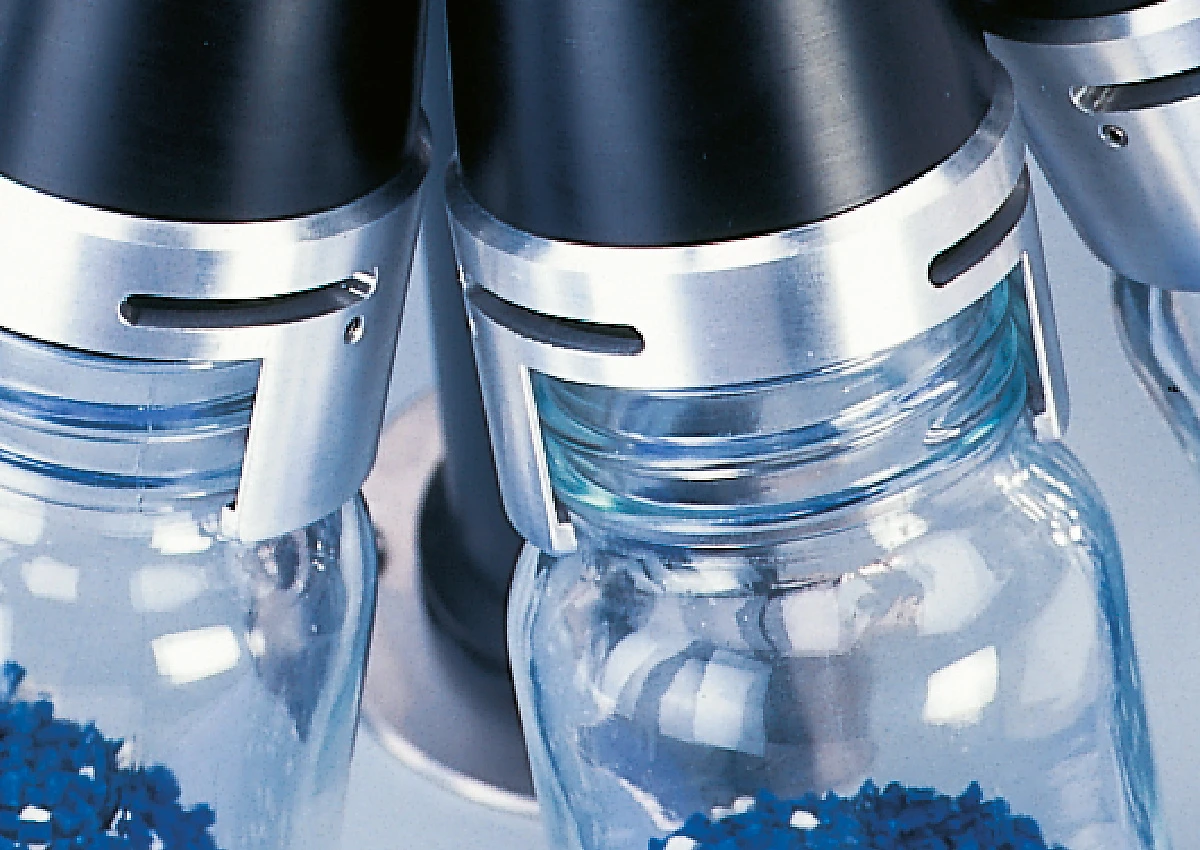
The principle of a rotating tube divider such as RETSCH’s PT 200 is slightly different (fig. 3, right). In contrast to the rotating sample divider, only the feeding tube which transports the sample is rotating. The outlet of this tube rotates over a laboratory bottle which collects the sub-sample. This method is used to extract a subsample from the sample flow and not to divide it.
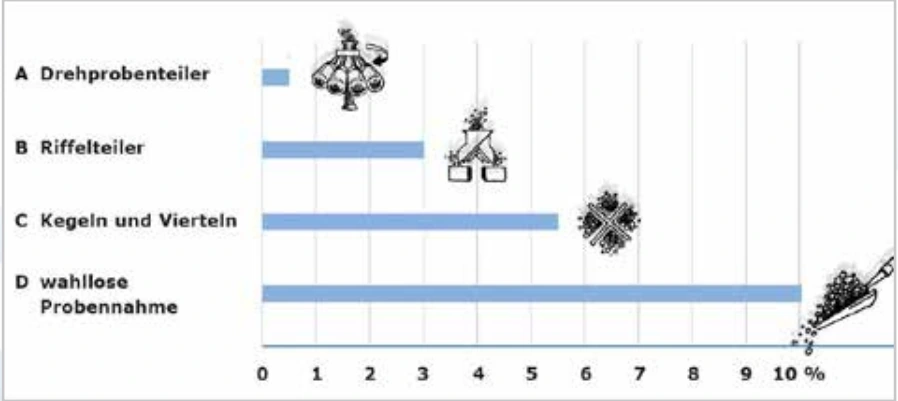
What is the effect of these different dividing methods on the analysis results? The representativeness of a part sample is considerably influenced by random errors. The sample division method has an influence on the impact of the random error. Random sampling cannot be identically repeated, i.e. the random error has a great impact. With coning and quartering the random error is reduced because a fixed dividing cross is used. However, due to the manual piling of the sample the even distribution of properties within the conical heap cannot be ensured. The sample splitter provides better results as the division process is executed by a defined tool. However, the fact that the sample is fed in manually is again a potential source of errors. In rotating sample dividers and rotating tube dividers the sample feeding and the division itself are automated. If the division is carried out with fixed parameters (rotation speed, feeding speed), the sample and thus its properties are evenly distributed into the laboratory bottles or collectors and the sub-samples represent the initial sample. If the division is repeated with identical parameters, it provides comparable results so that the analysis is also reproducible. All the described division methods provide better results than manual sample division with a spoon .
RETSCH offers sample splitters of various sizes
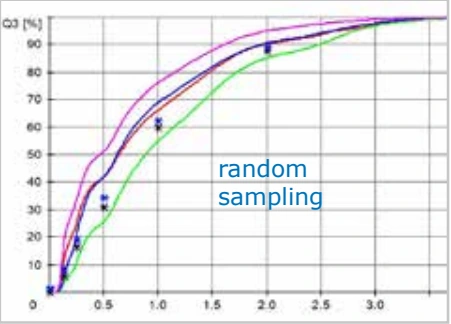
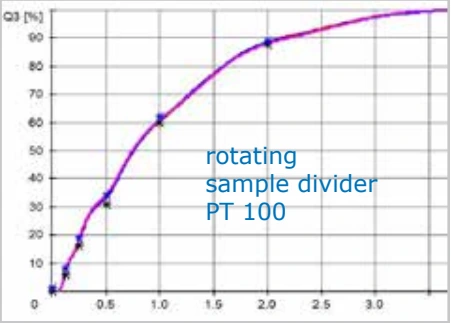
To demonstrate the influence of correct sample division on analytical results, regular sand was divided manually (randomly) or splitted by using a PT 100 . In each case, 4 sub-samples were sieved to determine the particle size distribution. While the particle size distribution curves of the randomly taken sub-samples differ, those representing the automated splitting show virtually identical results.
random sampling
rotating sample divider PT 100
Sample splitter for quick on-site sample division
Although sample splitters are not as accurate as automated dividing systems, there are still some applications where they provide good results, e. g. for on-site reduction of sample material. They are easy to use, easy to clean and don’t need electrical power. One of the receptacles is used to pour a well-mixed sample evenly into the dividing head. The material runs through the alternately arranged passages in the opposite direction into the two collecting receptacles under the dividing head outlets. With every operation the feed sample is halved. This can be repeated as many times as necessary until the required dividing quantity has been obtained. RETSCH offers sample splitters in seven different sizes, from very small sample amounts ≤3 L (RT 6.5) and larger quantities up to 16 L (RT 12.5 – RT 75) through to volumes ≤30 L (RT 100, see Table 1). The RT 100 is equipped with a feed hopper with closed outlet, thus, up to 30 l sample material may be evenly spread over the entire width of the hopper. The outlet is opened manually by moving a lever and the sample is splitted. The slots of the dividing head can be adjusted to a maximum width of 108 mm.
Specification of RETSCH´s Sample Splitters
| Sample splitter | Max. feed size | Max. Batch size (feed quantity) |
|---|---|---|
| RT 6.5 | 4 mm | ≤ 3 l |
| RT 12.5 | 8 mm | ≤3 L |
| RT 25 | 16 mm | ≤ 16 l |
| RT37.5 | 25 mm | ≤16 L |
| RT 50 | 33 mm | ≤16 L |
| RT 75 | 50 mm | ≤16 L |
| RT 100 | Depending on the variable slot settings: 12 / 24 / 36 / 48 / 60 / 72 / 84 / 96 / 108 mm | ≤ 30 l |
RETSCH's Sample Dividers – for each application the perfect choice
To cover a wide range of application requirements, RETSCH offers four types of automated sample dividers (Table 2, figure 7). They differ for example in the possible feed quantity, number and volume of sub-samples and maximum feed size. Small sample volumes up to 5 l are best divided in the PT 100. With the largest divider, the PT 600, sample volumes up to 60 l can be splitted in one go. RETSCH provides efficient solutions which help to improve working conditions and thus the quality of the sampling process.
RETSCH sample divider range
| Model | PT 100 | PT 200 | PT 300 | PT 600 |
|---|---|---|---|---|
| Dividing principle | Rotating sample divider | Rotary tube divider | Rotating sample divider | Rotating sample divider |
| Revolution speed | 110 min-1 | 50 min-1 | 18 – 53 min-1 | 18 – 53 min-1 |
| Feed quantity | 5 l | 30 l | 30 l | 60 l |
| Max. feed size | < 10 mm | < 10 mm | < 20 mm | < 20 mm |
| No. of sub-samples (without reject) | 6, 8 or 10 | - | 6, 8 or 10 | 6, 8 or 10 |
| No. of sub-samples (with reject) | - | 1, 2 or 3 | 1 | 1 |
| Collecting receptacle for sub-samples (without reject) | 30, 100, 250, 500 ml | - | 3 l / 3.75 l / 5 l | 6 l / 7.5 l / 10 l |
| Collecting receptacle for sub-samples (with reject) | - | 250 ml 500 ml | 3 l | 6 l |
RETSCH offers different types of sample dividers. The benchtop unit PT 100, the floor model PT 200 and the large PT 300 /PT 600 (both machines have identical housings).
Automatic sample division of small sample volumes
Application example glass powder
A small glass powder sample of 500 g needs to be divided into 20 sub-samples. This can be easily done using the PT 100 with the cone for 10 glass bottles of 250 ml each. In the first step, the complete sample is divided, resulting in 10 x 50 g sub-samples. In a second step, 2 x 5 bottles are combined, so that the initial sample is now divided in two sub-samples of 250 g. Again, the PT 100 with the cone for 10 sample bottles is used to divide those two fractions into 2 x 10 sub-samples of 25 g each. The complete procedure takes about 10 minutes.
Tips & Tricks:
n Due to the particle size <200 µm, the sample tends to cake in the hopper or the feeding chute. By reducing the feed rate to 60%, caking effects were minimized, and continuous sample feeding was ensured. n Larger sample pieces could block the outlet of the feed hopper. Therefore, the gap between the outlet of the hopper and the feeding chute should be at least 3 times bigger than the largest particles in the sample. For example: When dividing sample pieces of 5 mm size, a 15 mm gap should be chosen to obtain good results.
Rotating Tube Divider PT 200: How to calculate the required slot width
The Rotating Tube Divider PT 200 can be equipped with a bottom cone with 1, 2 or 3 outlets. The amount of the sub-sample(s) is determined by the opening width of the bottom cone. The maximum opening width in the bottom cone with three outlets is 53 mm, 110 mm in the one with two outlets, and 159 mm in the cone with one outlet . The calculation of the opening width depends on the feed quantity QA and the required fraction QT at a fixed circumference of 795 mm.
Example: A part sample QT of 100 g should be extracted from a total sample amount QA of 2000 g. With the following formula, the gap opening width can be calculated:
X = (795 mm x 100)/2000 = 39.75 mm
Bottom conus of the PT 200 with one outlet. The gap width scale can be set from 0 to 170 mm.
This means, that a bottom conus with 1 outlet will extract one part-sample of 100 g from the 2 kg initial sample, if the gap width is set to 39.75 mm. A bottom conus with two outlets will provide two sup-samples of 100 g each, and the bottom conus with three outlets will yield three sub-samples of 100 g each.
Tips & Tricks:
n The accuracy of this calculation depends on the maximum particle size. The finer the feed quantity, the more precise the calculation. n The minimum opening width must correspond to at least three times the maximum particle size. Example: Particle size = 8 mm results in a minimum opening width = 3 x 8 = 24 mm. If the opening width is narrower, a lack of representativeness of the sub-sample is to be expected.
Clever solutions for sample division of large volumes
If 200 ml are to be extracted from 60 liters of sample, a sample splitter is often the first choice. A large-sized sample splitter has a feed hopper of 25 l max. and divides the sample into two parts of 12.5 l each in the first step. It is not recommended to split more sample material in one go because the collecting vessels might be difficult to lift due to their weight and the material might overflow. To obtain 200 ml of representative sample, approximately 20 sample splittings are necessary. It is more than doubtful if these part samples may still be called representative. Not to forget that the use of sample splitters involves dust exposure. RETSCH’s PT 600 sample divider is the perfectly efficient solution for exactly this type of application. In the PT 600 the sample is fed in a controlled continuous stream via a vibratory chute. Either one part-sample is extracted, or the stream is divided into equal segments by the action of a “circle” of segmental buckets rotating beneath it.
The instrument features two modules for either discontinuous or continuous operation with reject receptacle. Different volumes may be processed by simply exchanging the sample vessels; no additional instrument is required. Thanks to the differently sized segmental buckets it is also possible to extract single samples in varying volumes.
The previously mentioned sample of 60 l can thus be fed to the hopper in one go . In continuous mode the integrated vibratory chute transports the entire sample amount to a cone with outlet (module for one part-sample with reject), where the major part of the sample is collected in the reject receptacle. Inside the reject module is a 6 l sample vessel which collects a representative part sample of the complete sample stream with each rotation. After the first division step, the 6 l vessel is removed . Then the reject module is replaced with the module for discontinuous operation, containing 6, 8 or 10 segments (6 x 10 liters / 8 x 7.5 liters / 10 x 6 liters). This module is exclusively used for batch-wise sampling without reject. The first part sample of 6 liters is again fed to the hopper and reduced to the desired number of part samples with the module for discontinuous operation, for example 10 samples of 600 ml.
Both division processes don’t take longer than 10 minutes and not only offer considerable time saving but also consistent working conditions resulting in reliable sampling results; this is a clear advantage over manual sample division or using a sample splitter. Another pro: the PT 600 is quickly and easily cleaned because all parts coming into contact with the sample can be easily removed.
Conclusion
Faultless and reproducible analysis results are closely linked to an accurate sample handling. Only a sample representative of the initial material can provide meaningful results. Rotating dividers and rotating tube dividers are an important means to ensure the representativeness of a sample and thus the reproducibility of the analysis. Correct sample handling consequently minimizes the probability of a production stop due to incorrect analysis results as described at the beginning of this article. Thus, correct sample handling is the key to effective quality control.
Up to 60 l of sample material can be fed to the hopper of the PT 600 (above); removal of the 6 l sample vessel (middle); module with 8 segments (below)
Plan the configuration for your material.
Rotating division methods are useful to consider for suitable bulk materials, but feed behavior and the collection arrangement matter. Review the reduction ratio and how increments are delivered. Picking an attractive-looking portion from the top of a container is a different process from controlled division.
| Consideration | Information to provide |
|---|---|
| Original quantity | Total sample and variation |
| Division objective | Required portion mass |
| Material flow | Feeding and collection behavior |
How should the application examples be used?
The results describe the materials and configurations discussed here. Confirm equipment options, contact materials and operating conditions for your own sample before adopting a method. A demonstrated endpoint does not guarantee the same outcome for a different material.
Discuss material testing with Glen Mills or request further information or a quote.
Explore the equipment discussed
- RETSCH PT 100 Sample Divider
- RETSCH PT 200 Rotating Tube Divider
- RETSCH PT 300 Rotating Sample Divider