
Can a highly precise instrument compensate for biased sampling?
No. Instrument precision applies to the portion measured. It does not establish that the portion represents the original batch.
The following situation is typical for many production plants: After a routine quality check, the production process is stopped or an already produced batch is suspended, because the analysis results were not within the relevant critical values. But does the tested product really deviate from the specifications? The quality control managers are convinced of this because modern analysis instruments provide results with very low tolerances. The sample in question was tested several times and the result was confirmed. The question is why the product does not match the specifications although the production parameters have not been changed in any way. The possibility that the tested product is indeed deficient cannot be excluded. However, it is often not the product itself which causes irregular analysis results but a lack of understanding of the steps which come before the analysis. Analog to an iceberg which is for the greatest part under water, only a small part of the sum of errors is perceived whereas the major part of potential errors is not taken into account . One reason for this may be that the high accuracy of modern analytical equipment is regarded as
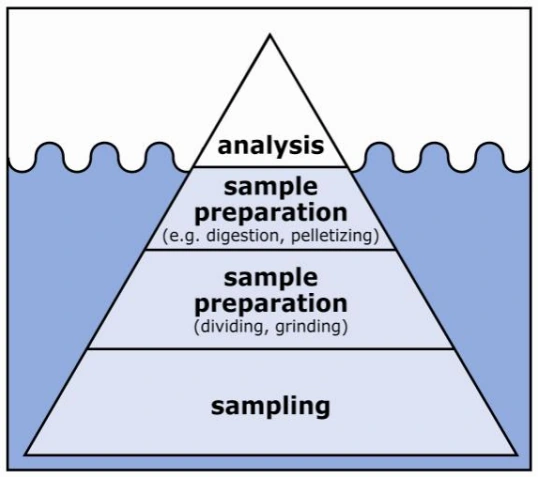
the maximum absolute error of the sample preparation process. Another reason may be the fact that sampling and sample preparation are done in a traditional way which has become a routine over the years and is no longer regarded as having a critical influence on the
subsequent analyses. The comparison demonstrates that the influence of an error in one of the described steps on the final analysis result can be much bigger than the error which finally occurs during analysis. Moreover, the errors of each step add up, i.e. the error increases during the process (error propagation). The question is now how these errors occur and what can be done to minimize them. In the following, these questions are discussed for the sampling and sample preparation of solids.
Sample handling
In general it can be said that the more heterogeneous a sample, the more
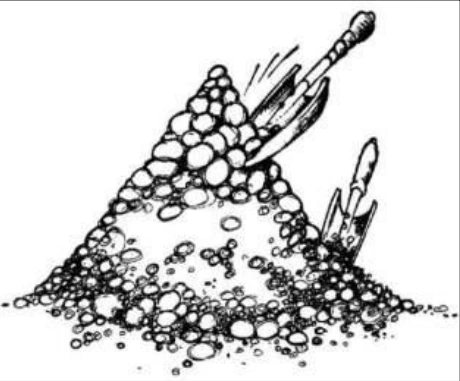
important the correct sample preparation. Let’s assume that a sample should be taken from a heap of sand. Which sample amount is necessary to represent the properties of the complete heap? Does it matter from which point of the heap the sample is taken? Figure 2 gives answers to both questions: The heap of sand consists
of a mixture of bigger stones and smaller sand grains. The stones are found in the upper part, the grains are at the bottom. If,
as shown in the picture, a sample is taken only from the upper or lower part of the heap, it consists mostly of stones or grains of sand respectively and is in no way representative of the complete heap. This effect is called segregation and it can be observed when a mixture consists of particles with different sizes or different specific densities. The particle size also has an influence on the sample amount: If 100 g of sample are
taken, obviously
considerably more sand grains than stones are needed to obtain the required mass. Also less obvious aspects can have an influence here: if the heap of sand was stored outside, then the material on the surface of the heap contains more moisture than the inside part. This means
that
the property
“moisture”
distributed heterogeneously
the
initial
material. As moist sand weighs more than dry sand, 100 g of sample from the surface of the heap contain fewer sand grains than 100 g of sample taken from inside the heap. In both
cases the required sample amount varies due to the properties of the initial material. The
required sample amount depends on the distribution range of the properties in the initial material.
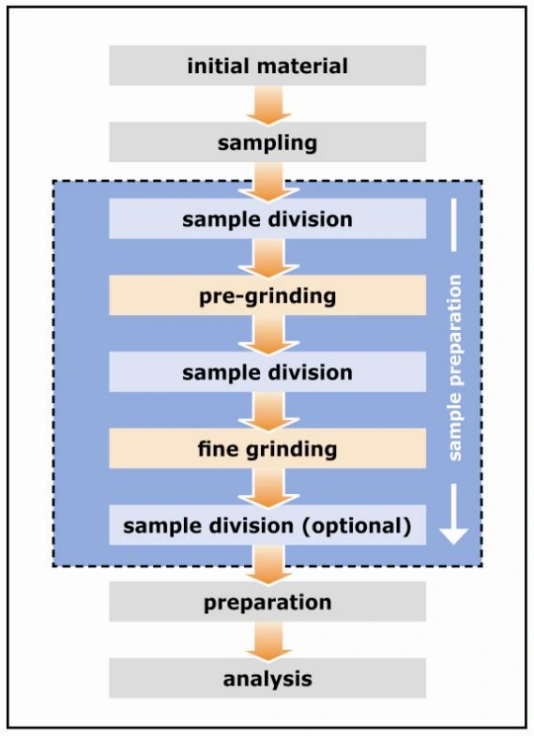
The wider the distribution and the lesser the frequency of properties in a sample are, the more sample material is required. This simple example demonstrates that the sampling and the complete sample handling are strongly influenced by the properties of the initial material. The comparison shows the sample handling process. Each step is discussed in the following with regards to its influence on meaningful analysis results.
Sampling
Once determined which properties are to be analyzed, the sample handling process starts with sampling from the initial material. As explained before, it is essential to obtain a representative sample. This means the sample must “represent” all properties of the initial material with statistical security. Consequently, samples in the aforementioned example must be taken from different points in the heap to ensure that the distribution of large and small as well as dry and moist sand grains is fully covered. Moreover, sampling should be free of random error sources which influence the representativeness in a negative way. For many materials the sampling procedure is laid down in DIN standards which also describe the suitable tools. Reproducible results can only be obtained if the sample is representative and if random errors during sample handling have been minimized. This should always be taken into account during each step of the process
If a representative sample has been taken, it should have the same properties as the initial material. The sample may show heterogeneously distributed properties as well as segregation effects. During the transport of bulk goods, the larger particles always settle in the upper part of the bulk and the smaller particles at the bottom. That is uncritical if the entire sample is used for analysis. In most cases, however, only a small part of the sample is required so that the volume needs to be reduced. There are two ways to obtain a representative sub-sample: sample division and grinding. Sample division is used to reduce the sample volume. Grinding improves the mixing properties and homogenizes the sample. A representative sub-sample can also be obtained by combining the three methods, taking into account the product properties and subsequent analysis method. Care must be taken that the properties of the sample are not altered by the preparation process. This can also be explained with our example: if the particle size distribution of the sand sample is to be determined, the sample
must not be ground. If the moisture content is analyzed, the sample must not be heated to prevent the contained water from evaporating. In the following the two sample preparation methods are discussed in detail.
Sample division
If all properties are distributed evenly in the sample and if there is no segregation, a small part of the sample could be extracted, e.g. with a spoon.
However, it is much more common that the
properties
are
distributed
heterogeneously or
that
the exact
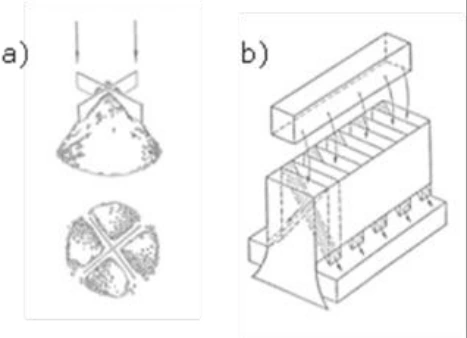
distribution of the properties is unknown. In such cases, a simple yet representative extraction of a sub-sample is almost impossible. Standardized methods such
as coning and quartering or the use of sample splitters or
rotating sample
dividers may be useful. For coning and
quartering (fig. 4a), the sample is formed into a conical heap and then divided into 4 equal parts. Now two opposite quarters are mixed and further quartered by the same method until an appropriate sample volume remains for analysis. Figure 4 b shows the function principle of a sample splitter. The sample splitter is equipped with an even number of equally sized passages which have alternating outlets to the right and left side. The sample is poured from the top into the sample splitter. As all the passages have the same size and each side has the same number of outlets, the sample is split into two equal halves. By further dividing one half, the sub-sample can be further reduced.
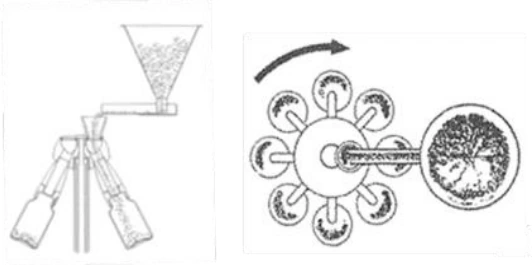
In a rotating sample divider, the sample is fed into the hopper and automatically transported via a feed chute to the openings of an evenly rotating dividing head . The sample falls from the end of the chute into the rotating dividing head which divides the sample flow into 6, 8 or 10 sub-samples, depending on the number of outlets. After the division, several sub-samples can be merged or one sub-sample can be further divided.
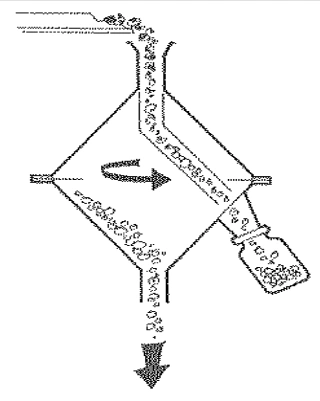
To divide larger sample amounts, a rotary tube divider is the tool of choice . In contrast to the rotating sample divider, only the feeding tube which transports the sample is rotating. The outlet of this tube rotates over a laboratory bottle which collects the sub-sample. This method is used to extract a sub-sample from the sample flow and not to divide it.
What is the effect of these different dividing methods on the analysis results? As explained at
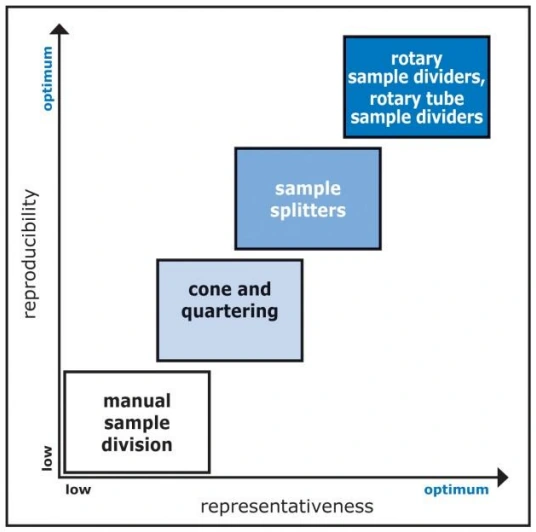
the beginning, reproducible analysis results can only be achieved if the sample is representative of the initial material. This representativeness is considerably influenced by random errors. The sample division method has an influence on the impact of the random error. Random sampling as described in the first part cannot be identically repeated, i.e. the random error has a great impact. With coning and quartering the random error is reduced because a fixed dividing cross is used. However, due to the manual piling of the sample the even distribution of properties within the conical heap cannot be assured. Especially a possible segregation of the laboratory sample during the piling process can have a negative effect. The sample splitter provides better results as the division process is realized by a defined tool. However, the fact that the sample is fed in manually is again a potential source of errors. In rotating sample dividers and rotary tube dividers the sample feeding and the division itself
are automated. If the division is carried out with fixed parameters (rotation speed, feeding speed), the sample and thus its properties are evenly distributed into the laboratory bottles. The sub-sample represents the initial sample. If the division
is repeated with
identical
parameters, it provides comparable results so that the analysis is also reproducible. All the described division
methods provide better results than manual sample division with a spoon .
Grinding
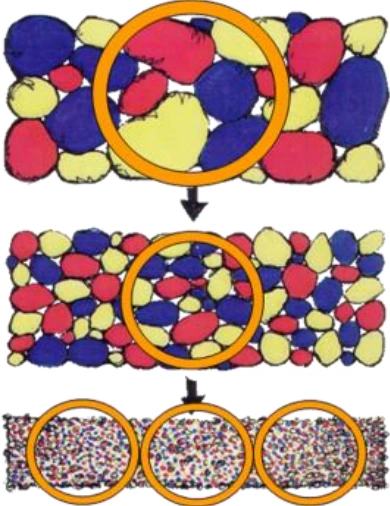
Many laboratory samples are unsuitable for a direct analysis, e.g. due to large particles or segregation due to different particle sizes. For large particles it is often only possible to analyze the properties of the surface, not what is inside. Segregation effects have already been described earlier. Grinding the sample can be helpful in such cases. Larger particles are reduced in size so that their insides can be analyzed,
too. Moreover, heterogeneously
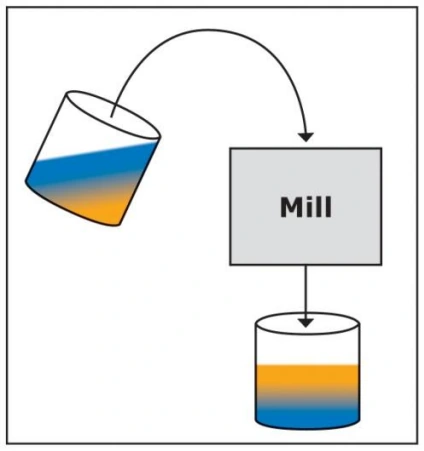
distributed properties are ideally distributed homogeneously by the grinding process. The comparison shows the effects of grinding. The following part explains how a correct sample division can help to ensure the representativeness and reproducibility of the sub-sample. In
the context of sample handling
for
subsequent analysis, usually only a limited sample volume can be pulverized. That is why the sample is often divided before the grinding process and only the reduced, representative sample volume is then ground. This procedure helps to reduce the time needed for sample preparation as well as the costs involved. Sample division can also be
useful
after
grinding.
complete
homogenization of the properties during grinding is the ideal case; in reality, however, it is often prevented by various effects.
In continuous
grinding processes, for example, the sample is hardly mixed. If a segregated sample is fed into the mill, the previously separated properties are
then found in reversed order in the ground sample . By dividing the sample with a sample divider after grinding, the properties can be distributed evenly to the sub-samples which ensures reproducibility.
Final preparation prior to analysis
Many analysis methods stipulate a defined state for the test sample. The term sample preparation comprises all activities which put the sample into the required state. This can be done, for example, by digestion with acids, or by pressing the sample into a tablet. The type of preparation depends on the subsequent analysis.
Conclusion
A faultless and comparable analysis is closely linked to an accurate sample handling. Only a sample representative of the initial material can provide meaningful analysis results. Rotating dividers and rotary tube dividers are an important means to ensure the representativeness of a sample and thus the reproducibility of the analysis. Correct sample handling consequently minimizes the probability of a production stop due to incorrect analysis results as described at the beginning of this article. Thus correct sample handling is the key to effective quality control.
Plan the configuration for your material.
Review the complete path from original sample to analytical portion when investigating inconsistent results. A precise instrument cannot remove a bias introduced during division or transfer. Record each change in quantity and physical form so that preparation can be assessed rather than assumed.
| Consideration | Information to provide |
|---|---|
| Sample path | Collection through analytical portion |
| Reduction record | Division and transfer stages |
| Investigation | Preparation variability versus measurement variability |
How should the application examples be used?
The results describe the materials and configurations discussed here. Confirm equipment options, contact materials and operating conditions for your own sample before adopting a method. A demonstrated endpoint does not guarantee the same outcome for a different material.
Discuss material testing with Glen Mills or request further information or a quote.