
Does milling make hazardous tailings suitable for reuse?
No. Reuse suitability requires the applicable compositional, performance and environmental evaluation beyond the milling step.
Mine wastes, commonly referred to as tailings, is the byproduct generated during the extraction and processing of various kinds of ores. This waste material primarily consists of finely ground rock particles, water, and residual chemicals used in the extraction process. The management and disposal of mine wastes are crucial due to its potential environmental impacts, which include soil and water contamination. If not properly managed, these tailings can lead to significant ecological damage, affecting both terrestrial and aquatic ecosystems.
To mitigate these environmental risks and simultaneously promote the valorisation of secondary mineral resources available in Europe, effective recycling and reuse strategies are essential. In this context, the Horizon Europe START project* (“Sustainable Energy Harvesting Systems Based on Innovative Mine Waste Recycling”, is transforming waste secondary sulphide materials in sustainable high added-value components for tellurium-free thermoelectric devices, thus contributing to more sustainable industrial processes. Additionally, innovative approaches to tailings management, such as the development of new technologies for waste treatment and the implementation of
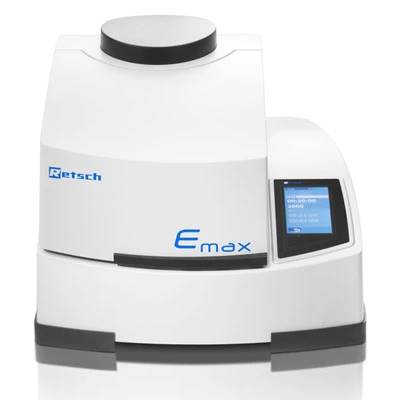
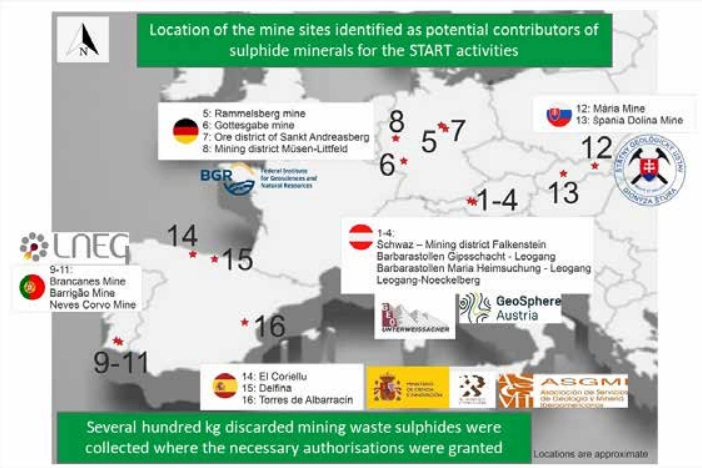
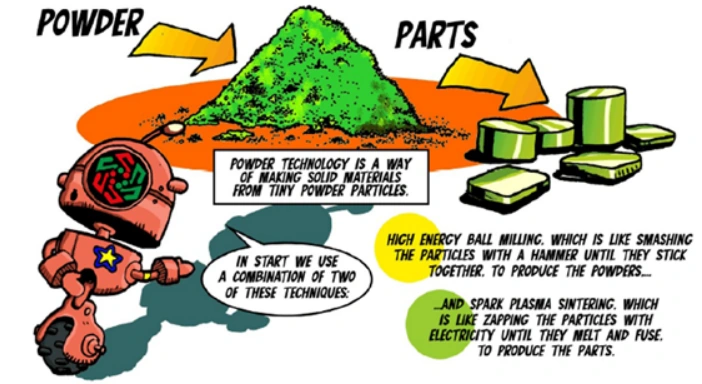
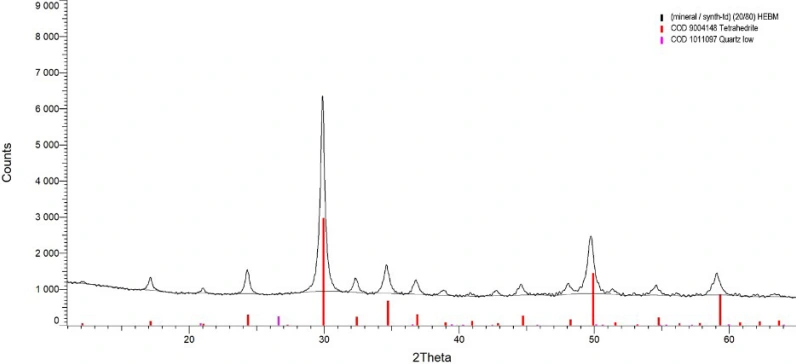
stricter environmental regulations, can further reduce the negative impacts of copper mining on the environment. The overall concept of the START project of “transforming mining waste into waste heat recovery materials” translates into the production of p-type semiconductor materials that incorporate discarded residual secondary sulphides, mainly tetrahedrite, a widely available copper-antimony sulfosalt mineral that does not contain tellurium. Sites containing these suitable sulphide minerals were identified in various historical European mines, based on the volume of sulphides, the presence and content of tetrahedrite, and accessibility and logistical issues . The production of the mineral-derived tetrahedrite p-type materials is being carried out by powder technology . On a laboratory scale, the powders are produced at LNEG facilities using the High Energy Ball Mill Emax. The unique characteristics of Emax, and in particular the high levels of mechanical energy input, allow the reactivity of the powders to be changed so that the direct synthesis of nanostructured mineral-derived tetrahedrite powders occurs near room temperature .
The High Energy Ball Mill Emax
The Emax is an entirely new type of ball mill designed for high-energy milling. Its unique combination of high friction and impact results in extremely fine particles within the shortest amount of time. This innovative ball mill offers faster and finer grinding than any other ball mill available. With a speed of 2000 min-1, it allows for ultra-fast pulverization of samples. Additionally, the Emax features water cooling, which permits continuous operation without the need for cool-down breaks. The temperature-controlled grinding ensures consistent results, and the special jar design improves the mixing of the sample, resulting in a narrow particle size distribution.
High Energy Ball Mill Emax
Functional principle: Grind sizes in the submicron range
The High Energy Ball Mill Emax combines high-frequency impact, intensive friction, and controlled circular jar movements to a unique and highly effective size reduction mechanism. The grinding jars have an oval shape and are mounted on two discs respectively which move the jars on a circular course without changing their orientation. The interplay of jar geometry and movement causes strong friction between the grinding balls, sample material and jar walls as well as a rapid acceleration which lets the balls impact with great force on the sample at the rounded ends of the jars. This significantly improves the mixing of the particles resulting in smaller grind sizes and a narrower particle size distribution than is possible to achieve in ball mills.
* START project (project number: 101058632) is co-funded by the European Union. Views and opinions expressed are however those of the authors only and do not necessarily reflect those of the European Union or the European Health and Digital Executive Agency. Neither the European Union nor the granting authority can be held responsible for them.
Plan the configuration for your material.
Distinguish reducing particle size from demonstrating safe reuse. Describe the tailings source and intended transformation, then characterize the treated material using the appropriate tests. A laboratory preparation result does not establish that a waste stream meets environmental or product requirements.
| Consideration | Information to provide |
|---|---|
| Tailings identity | Source and composition |
| Research objective | Size or material transformation |
| Evaluation | Intended reuse and relevant testing |
How should the application examples be used?
The results describe the materials and configurations discussed here. Confirm equipment options, contact materials and operating conditions for your own sample before adopting a method. A demonstrated endpoint does not guarantee the same outcome for a different material.
Discuss material testing with Glen Mills or request further information or a quote.