
ULTRASONIC LIQUID PROCESSING
Sonitube continuous-flow ultrasonic reactor
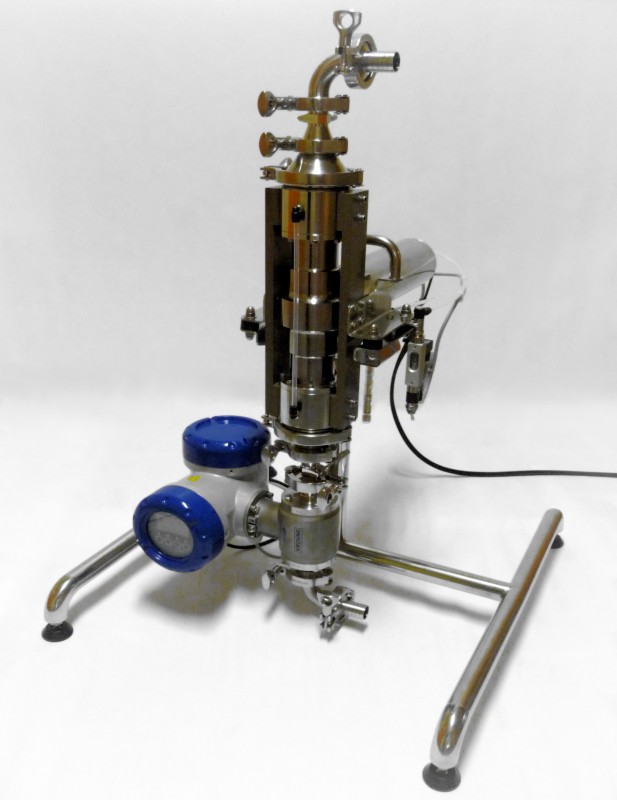
Sonitube is a tubular ultrasonic reactor for continuous treatment of liquids and suspensions. Its vibrating tube creates cavitation as liquid passes through. Compare 20 and 35 kHz configurations for single-pass or recirculating operation.
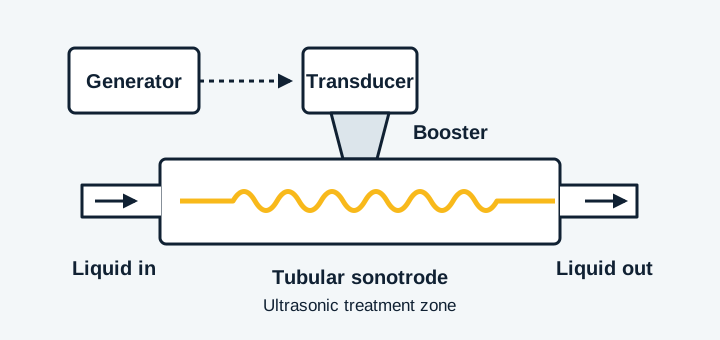
How the vibrating tube treats liquid
A generator drives a transducer, which converts the electrical signal into mechanical vibration. The booster couples that vibration to the tubular sonotrode. The tube wall vibrates at resonance and produces cavitation in the passing liquid. The formation and collapse of bubbles creates local shear.
The treatment chamber has no rotating agitator. The reactor can be installed inline or in a loop that returns liquid to a vessel between passes.
Compare the 20 and 35 kHz configurations
| Configuration | Electrical power | Published flow | Active volume |
|---|---|---|---|
| 35 kHz standard | 200–400 W | 100–300 L/h | 70 mL |
| 20 kHz industrial unit | 600–1,250 W | 200–500 L/h | Confirm for this unit |
Active volume is the liquid volume in the treatment zone. Electrical input power is separate from the acoustic power delivered to the liquid. Achievable flow depends on your material and the treatment it needs. Confirm specifications and availability with Glen Mills.
Historical specification: A 2012 standard 20 kHz configuration was described at 600–1,500 W, 300–600 L/h and 700 mL active volume. These figures apply to that historical configuration.
Single pass
Route the feed through the reactor to the next stage. Set the flow based on the treatment required in one pass.
Recirculating batch
Return liquid to a stirred vessel for repeated passes. Track the total treatment time and product temperature.
Semi-batch
Evaluate a vessel and feed arrangement suited to staged additions or changing process conditions.
From bench equipment to enclosed systems
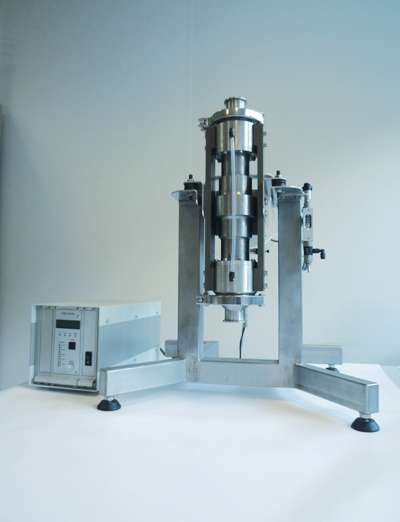
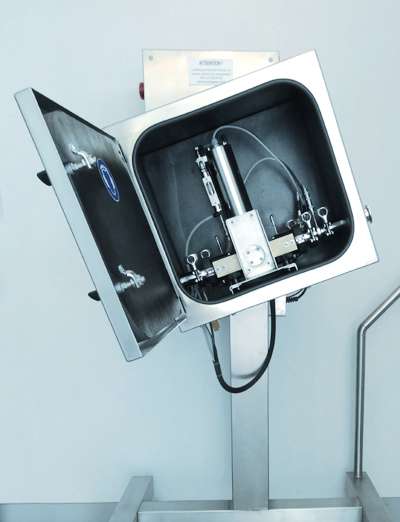
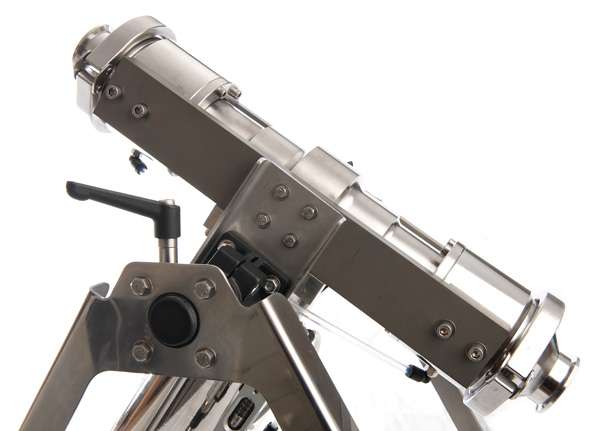
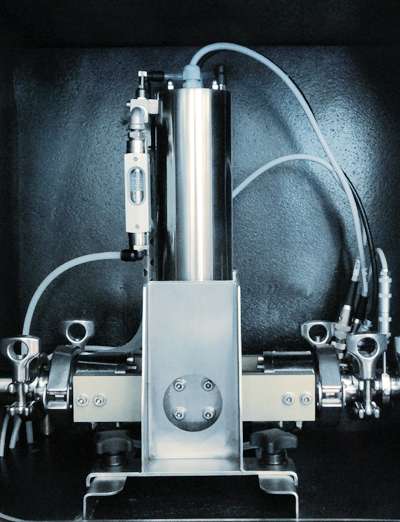
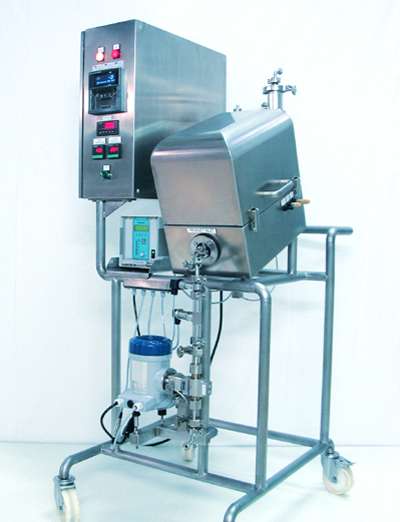
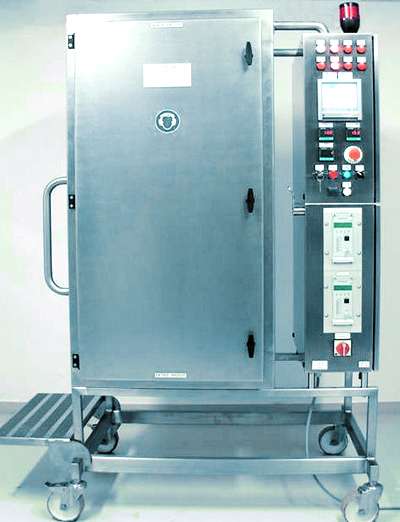
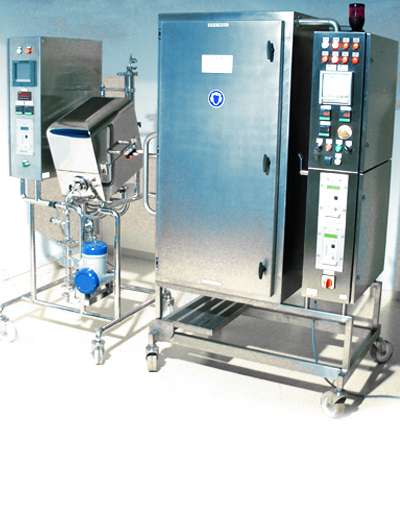
These equipment photos show how the reactor, generator, pipework and controls can be arranged. Select any image to enlarge it.
What do you want to change in the liquid?
Start with the outcome you can measure. Liquids, liquid blends and solid–liquid suspensions can respond differently to the same setting.
Dispersion and deagglomeration
Break up powder agglomerates in a liquid carrier. For ceramic slurries, measure particle size and check how the dispersion holds before spray drying.
Homogenization and emulsification
Evaluate uniformity in liquid blends and droplet size in emulsions. Check whether the result holds after storage.
Botanical extraction
Evaluate whether ultrasound improves recovery from plant material. Track yield, extract quality and temperature alongside an untreated control.
Viscosity adjustment
Measure whether treating a suspension changes its apparent viscosity before pumping or atomization. Record the temperature and measurement conditions.
Degassing
Evaluate whether sonication helps release entrained gas. Compare residual gas or bubble content before and after treatment.
Inline cleaning and process integration
Tubular systems can be configured for continuous cleaning or paired with other processing steps. Confirm the line layout, materials and cleaning requirements for your installation.
Configure the reactor around your line
Configuration options include sound reduction, flow and temperature monitoring, data recording, a jacketed stirred vessel and a heat exchanger. Touchscreen and Ethernet options are listed for the 20 kHz industrial unit.
- Product and wetted parts
- Confirm liquid chemistry, solids loading, viscosity and the compatibility of seals and other wetted parts.
- Temperature and pressure
- Specify allowable product temperatures, line pressure, cooling needs and connection sizes.
- Cleaning and documentation
- Ask which configurations support clean-in-place or sterilize-in-place. If qualification is required, confirm which installation and operational qualification documents are supplied with the quoted unit.
Discuss your process with Glen Mills
Tell us what you are processing, your target flow or batch size, and the result you need to measure. Include any temperature limits or installation requirements so we can discuss a suitable configuration and quote.
Common questions
How is it different from a probe sonicator?
A typical batch probe sits in a vessel. Sonitube uses a vibrating tube as the flow chamber, so liquid can pass through it inline or recirculate from a vessel.
What flow rate can I expect?
The published ranges are 100–300 L/h for the standard 35 kHz unit and 200–500 L/h for the listed industrial 20 kHz unit. Confirm the achievable flow for your material and target result.
When is recirculation useful?
Recirculation lets a batch pass through the treatment zone more than once. It is useful to evaluate when one pass does not achieve the target result and the product temperature can be controlled.
What should I include in a quote request?
Include the liquid or suspension, target flow or batch size, desired result, temperature limits, and any line, cleaning or documentation requirements.
Which frequency should I choose?
Compare the active volume, electrical power and expected throughput together. Use your material and target result to decide what to evaluate.
Can I use it with a heat-sensitive liquid?
Discuss a jacketed vessel or heat exchanger. Monitor product temperature during evaluation to see whether the proposed setup stays within your limit.