
Can a normal powder-recovery procedure be used for gas analysis?
Not without assessing the gas-handling objective. Collection, transfer and background control must be designed around the component being measured.
"Why are we interested in methane deep within rocks? The analysis of methane and its isotopic ratio from tiny fluid inclusions trapped in minerals provides valuable insights into the formation and evolution of our planet. For example, it enables us to distinguish whether methane originated from biological processes, geochemical reactions, or thermal decomposition. This knowledge is crucial for a better understanding of global carbon cycles, energy resources, and environmental developments." The research group led by Prof. Vitale Brovarone at the University of Bologna, Italy, is dedicated to investigating these questions. The methodological details and validation of the analytics described here have been thoroughly documented in a recent study by Olivieri et al. (2024).
Methodological Approach
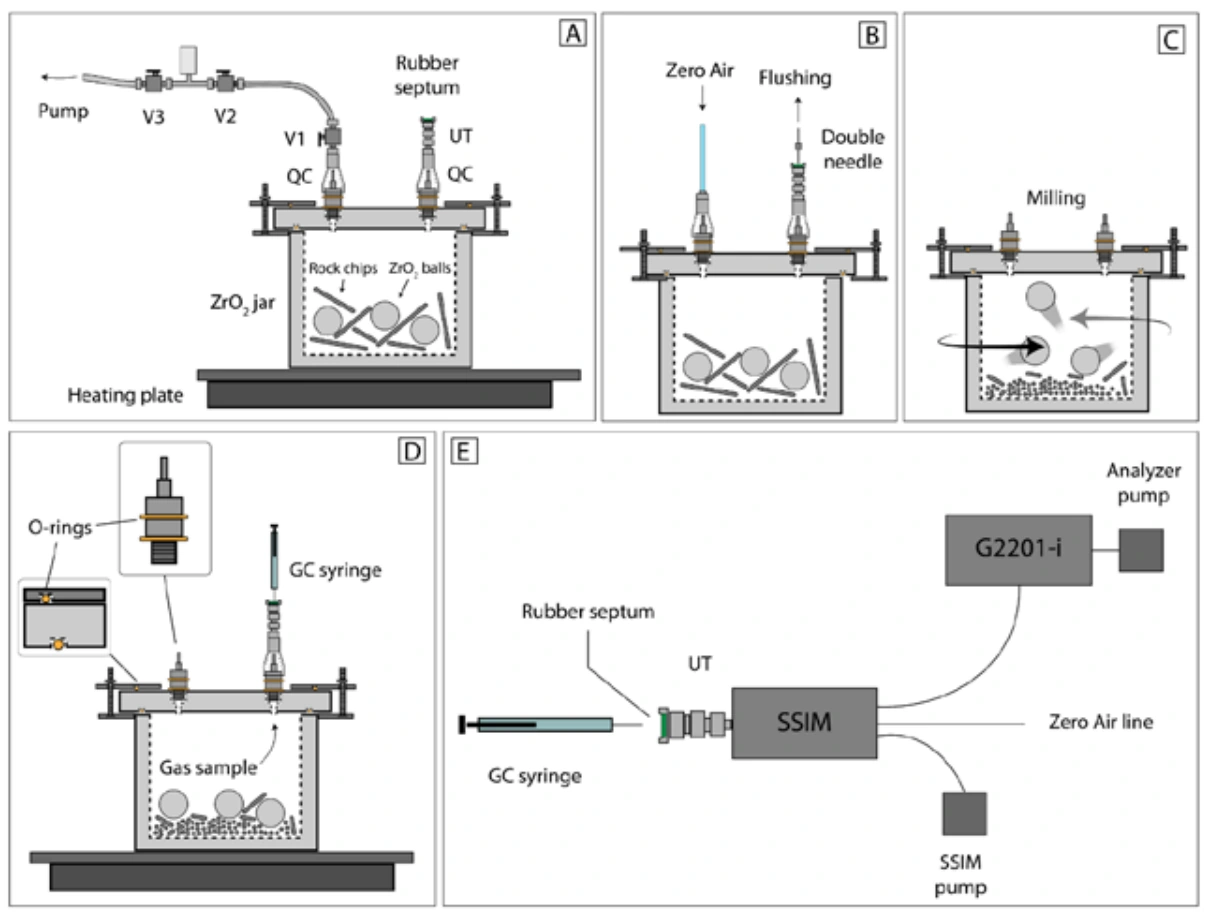
To release methane from fluid inclusions, rock samples were ground using Planetary Ball Mill PM 100 and 250 ml jars made of zirconium oxide. The jars were hermetically sealed with a safety closure device in combination with special RETSCH aeration lids , evacuated, and flushed with zero air to avoid contamination. Thanks to the aeration lids, the released gases could be extracted directly after milling without opening the system.
Aeration lids offered in different materials and Planetary Ball Mill PM 100
illustrates the test setup and the most important components of the system. The analysis of methane concentrations was performed using Cavity Ring-Down Spectroscopy (CRDS), a highly precise spectroscopic method. The extraction protocol, artifact minimization strategies, and interlaboratory comparison of similar setups are critically discussed in Olivieri et al. (2024).
Results and Conclusion
The methane trapped in rocks can be extracted and analyzed using this setup. By comparing two jar materials (steel and zirconium oxide) under identical conditions, it is also possible to assess whether the vessel material influences the measurement results and how it affects the reproducibility of the analyses. RETSCH Planetary Ball Mills, such as the PM 100, are known for high performance and precision. They accommodate jars and adapters from 1.5 ml vials up to 500 ml jars, with up to four grinding stations. User-friendly settings allow easy control of time, speed, and cycle programs. Equipment options include safety closures, a pressure and temperature control unit, and an aeration lid with interchangeable inlays for use with steel, zirconium oxide, tungsten carbide, or agate jars . RETSCH mills and the appropriate accessories provide a reliable basis for safe and reproducible analysis. As shown, this enables precise geochemical
investigations and offers an
important
contribution to better understanding the geological secrets of our planet.
Olivieri, Orlando Sébastien, et al., Frontiers in Earth Science 12 (2024): 1438382.
Plan the configuration for your material.
The collection pathway is part of the experiment. Define how released gas will reach the analytical system and how background contributions will be assessed. Ordinary open recovery of a powder would address a different measurement objective from collecting gas released during preparation.
| Consideration | Information to provide |
|---|---|
| Rock sample | Mineral and inclusion context |
| Collection route | Supported jar and connection arrangement |
| Controls | Background and gas-analysis method |
How should the application examples be used?
The results describe the materials and configurations discussed here. Confirm equipment options, contact materials and operating conditions for your own sample before adopting a method. A demonstrated endpoint does not guarantee the same outcome for a different material.
Discuss material testing with Glen Mills or request further information or a quote.