
Does a planetary-mill setting fully define the prepared material?
No. Material properties, tools, loading and measurement all contribute to the result and need to be recorded with the operating program.
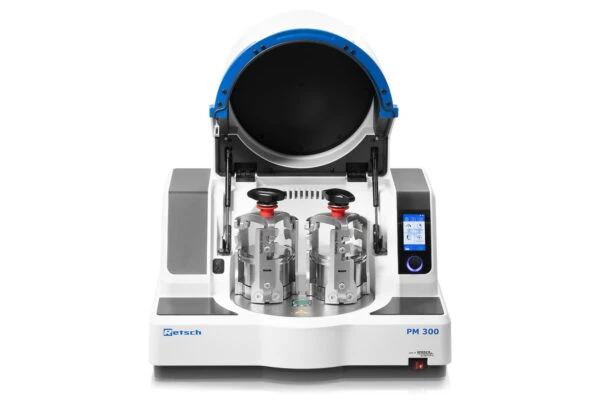
Planetary ball mills meet and exceed all requirements for fast and reproducible grinding to analytical fineness. They are used for the most demanding tasks in the laboratory, from routine sample processing to colloidal grinding and advanced materials development. With the PM 300 RETSCH has developed a powerful tool which offers high sample throughput combined with ease-of-use.
Thanks to extremely high centrifugal forces which result in very high pulverization energy, planetary ball mills process soft, hard, brittle, and fibrous materials in dry or wet mode in a very short time. They are ideally suited for tasks in research, like mechanochemistry (mechano-synthesis, mechanical alloying and mechanocatalysis), but also for ultrafine colloidal grinding on a nanometer scale. A crucial advantage of planetary ball mills is their great versatility: They are available with different numbers of grinding stations and can be operated with jars and balls of various sizes and materials.
The ”Planetary” Principle In the planetary ball mill, every grinding jar represents a “planet”. This planet is located on a circular platform, the so-called sun wheel. When the sun wheel turns, every grinding jar rotates around its own axis, but in the opposite direction. Thus, centrifugal and Coriolis forces are activated, leading to a rapid acceleration of the grinding balls. The result is very high pulverization energy allowing for the production of very fine particles. The enormous acceleration of the grinding balls from one wall of the jar to the other produces a strong impact effect on the sample material and leads to additional grinding effects through friction. For
Planetary Ball MIll PM 300
colloidal grinding and most other applications, the ratio between the speed of the sun wheel and the speed of the grinding jar is 1: -2. This means that during one rotation of the sun wheel, the grinding jars rotate twice in the opposite direction.
Operation and Accessories With the development of the Planetary Ball Mill PM 300 RETSCH has closed a gap in the product portfolio. This benchtop model with two grinding stations accepts grinding jar volumes up to 500 ml which results in a maximum batch size of 2 x 220 ml sample material.
Thanks to the maximum speed of 800 rpm and the enormous energy input of up to 64.4 times the acceleration of gravity, this mill is the perfect choice for tasks in research like mechanochemistry or for ultrafine colloidal grinding.
Taking into account that planetary ball mills are not as easy to handle as, for example, mixer mills, the PM 300 has been designed to offer utmost user convenience and safety:
Easy operation via button and touch display
I Sun wheel can be locked for easy and safe clamping of the grinding jars I The Safety Slider prevents starting the machine before the jars are securely clamped I Comfortable parameter setting via Touch display I Storage of 12 SOPs and 4 cycle programs I Programmable starting time or breaks, e. g. for cooling I Automatic calculation of the total process time I Direction reversal to minimize caking effects I Smart service interval notification based on usage I Range of accessories like safety closure device, aeration lids and GrindControl to measure temperature and pressure during operation
Stackable grinding jars In the PM 300, 4 samples can be processed in jars sized 12, 25, 50 or 80 ml . This option makes the machine interesting for applications, where only small sample volumes from 4 to 27 ml are available.
Stackable grinding jars
Effects of the increased energy input Planetary ball mills are typically used for nano-scale grinding. The achieved final fineness is usually influenced by the energy input . With a higher energy input a finer grind size can be expected, just like an increase in temperature – which results in a requirement for longer grinding breaks to keep the sample below a critical temperature. The high energy input of the PM 300 is a result of the maximum speed of 800 rpm and the large sun wheel.
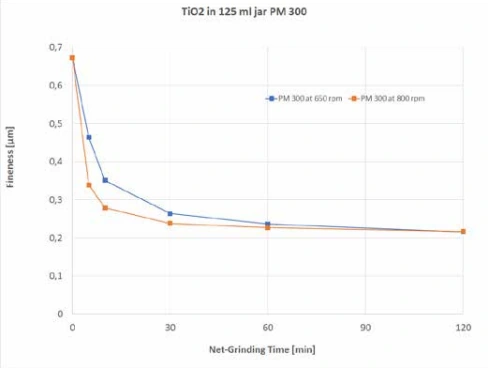
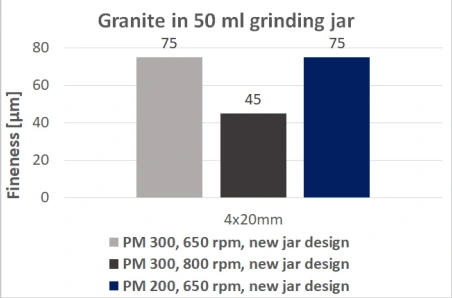
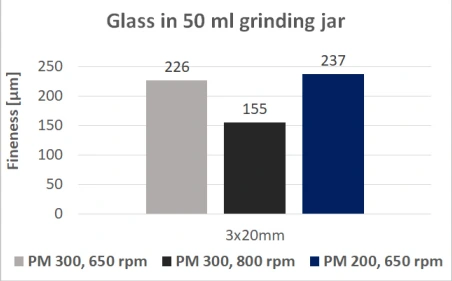
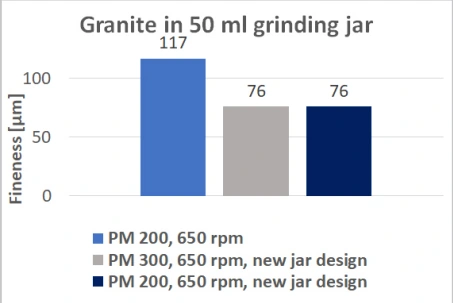
The larger sun wheel has less effect on the result than the maximum speed of 800 rpm as compared to 650 rpm for, e. g., a PM 200. The results achieved in the PM 300 using a 50 ml grinding jar and 4 x 20 ml grinding balls to pulverize granite samples are only marginally better compared to the process in the PM 200; both mills were operated with 650 rpm. When the speed in the PM 300 was increased to 800 rpm, the obtained particle size was 40 % finer. A similar effect has been observed while grinding glass particles with 3 x 20 mm balls. Here, the increased speed resulted in a particle size reduction of 30 %.
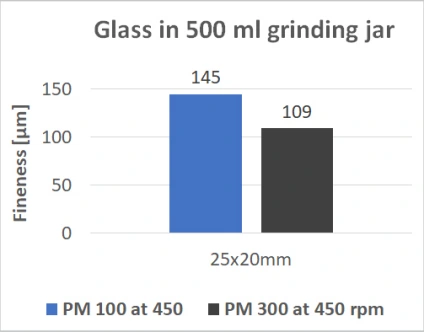
The influence of the larger sun wheel can also be observed when pulverizing glass in a large grinding jar of 500 ml with 25 x 20 mm grinding balls. When using the large grinding jar with large grinding balls, it is not recommended to operate the mill at high speed, as this will result in caking effects. When comparing the PM 300 results to those obtained with the PM 100, which is also capable to work with 500 ml jars, at 450 rpm , it can be seen that the effect of the larger sun wheel of the PM 300 produced 25 % finer particles.
New EasyFit grinding jars The PM 300 is the first planetary ball mill in the RETSCH portfolio to be operated exclusively with the new EasyFit grinding jars which replace the “comfort” jar line and are suitable for use in the entire RETSCH planetary ball mill portfolio. The speed of 800 rpm of the PM 300 result in higher forces which in turn increase the risk of undesired twists of the jars in the clamping system.
The new EasyFit jar line has a structure at the bottom of the 50-500 ml jars named Advanced Anti-Twist (AAT) feature, which ensures that the jars are kept in place without any danger of twisting. This could not be guaranteed with the “comfort” jar line. As the EasyFit jars will not perform any random rotations, wear is drastically reduced. Safely clamping the jars is greatly facilitated: To find the correct clamping position, a maximum twist of 60° is required.
EasyFit grinding jar line
The geometry of the EasyFit jars sized 50 ml and 250 ml has been increased in diameter and reduced in height compared to the comfort models.
This provides two advantages: better grinding results and exchangeable jar lids, as there are only three diameter dimensions for the whole jar line.
Three lid diameters for all jars:
I Diameter 1:
12 ml and 25 ml jar
I Diameter 2:
50 ml, 80 ml and 125 ml jar
I Diameter 3:
250 ml and 500 ml jar
With the new EasyFit grinding jar line, more options for jar materials and volumes for aeration lids or the temperature and pressure measurement system GrindControl have been realized.
Both the aeration lid and GrindControl can now be equipped with inlays of different materials. Thus, the lid can be used for, e. g. a steel and a zirconium oxide jar by simply exchanging the inlay.
Advantages of the EasyFit jar line:
I Safe clamping thanks to Advanced Anti-Twist feature (AAT) I Reduced wear I Interchangeable lids for identical diameters I Inlay solution allows using one lid for jars of various materials
Better grinding results with EasyFit jar design The influence of the large sun wheel on the grinding results is neglectable in case of the 50 ml grinding jars as described above. The comparison shows the effect of the improved diameter of the 50 ml jar. In both planetary ball mills, PM 200 and PM 300, the grinding result of a granite sample milled with 20 mm balls is 18 % finer with the new jar design.
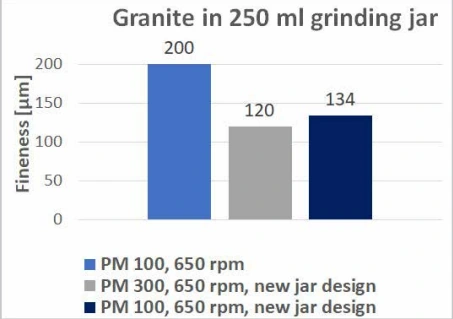
Similar observations were made for the new design of the 250 ml grinding jar with 10 mm grinding balls (40 % finer particles). Thus, also bearing in mind the better grinding results for e. g. 50 ml jars at 800 rpm , a particle size reduction from 117 µm (PM 200, old jar design, 650 rpm) to 45 µm (PM 300, flat jar design, 800 rpm) is possible (62 % finer particles).
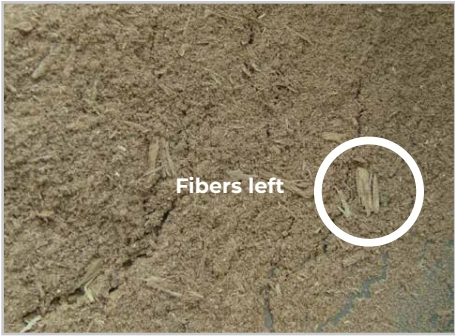
The flat jar design is also beneficial for milling fibrous samples . After some minutes of grinding dried plants, the results in the new 50 ml and 250 ml jars were much better both, in the PM 100 and the PM 300.
Perfectly homogeneous
Further options Aeration lids are the accessories of choice if the grinding process needs to be performed under inert conditions, for example under argon atmosphere, because oxygen affects the mechanochemical reaction inside the jar or the grinding process itself.
RETSCH’s GrindControl system monitors and records the development of pressure and temperature of a ball mill process. Monitoring the two variables "pressure" and "temperature" provides valuable information about what is happening inside the grinding jar. GrindControl is used to improve sample preparation, for example of temperature -sensitive materials, to control colloidal or long-term grinding processes, or to successfully perform material synthesis such as mechanical alloying or mechanochemical processes. The system consists of the pressure and temperature measurement hardware in the jar lid and an analysis software.
The new generation of aeration lids as well as the GrindControl system can only be used with the new EasyFit jar line. It comprises three different diameters as described above. GrindControl and the aeration lid are available for the diameter group 2 (50 ml, 80 ml, 125 ml) and group 3 (250 ml and 500 ml). Within the groups, one GrindControl or aeration lid can be used on the different jar sizes. RETSCH has developed an inlay solution for the two systems. This means, that they can be split into the basic unit and an inlay for easy cleaning. The inlay is available in different jar materials. As a result, one GrindControl system or one aeration lid is suitable to be used on, for example, steel jars or zirconium oxide jars. For the aeration lids, inlays are also available of tungsten carbide or agate.
GrindControl system on a 500 ml hardened stainless steel grinding jar
Modular design of the GrindControl system with inlays
Conclusion With the powerful, ergonomic benchtop Planetary Ball Mill PM 300 RETSCH covers a wide range of size reduction applications and increases the throughput thanks to two grinding stations for jars up to 500 ml. It is also suitable for pulverizing small sample volumes down to 3 ml. With the new grinding jar line EasyFit and new options for the GrindControl system and aeration lids this mill opens up new possibilities in ball milling.
Plan the configuration for your material.
Select jars, media and loading around the preparation purpose. A method intended to reduce particles is not the same as one designed to investigate a reaction or material transformation. Confirm the configuration and evaluate the prepared material rather than transferring operating settings between unlike samples.
| Consideration | Information to provide |
|---|---|
| Application goal | Analytical preparation or development |
| Grinding arrangement | Jars, media and load |
| Result definition | Size or material-characterization endpoint |
How should the application examples be used?
The results describe the materials and configurations discussed here. Confirm equipment options, contact materials and operating conditions for your own sample before adopting a method. A demonstrated endpoint does not guarantee the same outcome for a different material.
Discuss material testing with Glen Mills or request further information or a quote.